Showing posts with label Falco zoniventris. Show all posts

Friday, November 27, 2009

Barbary Falcon


The Barbary Falcon is a medium-sized falcon about the size of a crow.
This bird of prey breeds in the Canary Islands
and on the coasts of north Africa. It is mainly resident.

Saturday, November 21, 2009

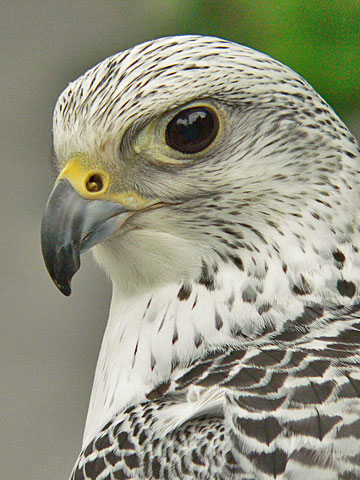
Gyrfalcon


The gyrfalcon is the largest of all falcon species.
The Gyrfalcon breeds on Arctic coasts and islands of North America, Europe and Asia.
It is mainly resident, but some Gyrfalcons disperse more widely
after the breeding season, or in winter .
Its scientific name is composed of the Latin terms for a falcon, Falco, and for
someone who lives in the countryside, rusticolus.
This species is a very large falcon, about the same size as the largest buteos.
Males are 48 to 61 cm long, weigh 805 to 1350 g
and have a wingspan from 110 to 130 cm (43 to 51 in).
Females are rather bulkier and larger at 51 to 65 cm (20 to 26 in) long,
a weight of 1180 to 2100 g (2.6 to 4.6 lbs) and have a wingspan ranging from 124 to 160 cm .
In dimensions, gyrfalcons lie between
a large Peregrine Falcon and a hawk in general structure; they are unmistakably falcons with pointed wings, but are stockier, broader-winged, and longer-tailed than the Peregrine.

Friday, November 6, 2009

Facts about falcons - 3


BABIES
* Eyases weigh 1 1/2 ounce when first hatched.
* Newly hatched, they are wet and covered with a white fuzz called "down"
. By 3 - 5 weeks the fuzz has been replaced by brown feathers.
* Males develop faster than females, females are larger and more powerful
when fully grown.
* In 3 weeks they are 10 times their birth weight; in 6 weeks they are
full grown; and at 9 - 12 weeks they begin to hunt and care for themselves.
* Their first prey is small game ~ dragonflies and butterflies.
* The first few days of learning to fly is dangerous to the young falcons, especially in
urban areas. Wind changes can slam the birds
into the ground and mirrored or illuminated windows are another hazard.
Unfortunately statistics are not on their side, only one out of two manage to survive the first year.

Facts about falcons - 2


NESTING / EGGS / HATCHING
* Their range is about 30 miles with their nest in the center of their range.
They do not like other falcons within 3 miles of their nest site.
* Their favorite spot for a nest is on the edge of a cliff. Their nesting ledge is called an "aerie".
* They don't use a lot of nesting material.
Peregrines prepare a saucer shaped indentation in lose soil, sand, or grass called "scrape".
* The tiercel (male) arrives at the nesting site and begins a lot of fancy aerial displays to attract his mate in early Spring. Sometimes the male will select several locations for a nest and the female makes the final decision.
The female is the boss of the house, and the male is cautious around her.
* Peregrines are ready to start a family when they are about 2 years old.
* Falcons lay 3 - 5 eggs, 2 to 3 days apart.
The group of eggs are called a "clutch".
* Eggs range from soft pink to reddish brown and are slightly
larger than a chicken egg - about the size of a duck egg.
* The male and female share the responsibility of sitting on (incubating) the eggs.
The eggs need to stay at a constant warm temperature and dry, or the embryo
will not survive. If the air temperature is warm, the parents will leave the eggs briefly to hunt.
* The eggs also need to be turned, which we've observed occurs as the birds shift around on the nest. There are times that it looks like the
birds are actually rolling the eggs with their mouth or feet.
* The length of incubation is 33 days from the time "active" incubation starts.
* "Pipping" the shell is when the "eyases" (babies) begin to hatch out.
They do this from the inside with an "egg tooth" (a tiny sharp point) on the end of their beak. The egg tooth disappears almost immediately.
This process can take up to 2 days!

Facts about falcons - 1


Peregrines adapt to their environment and live on every continent except Antarctica.
They can live in the mountains, deserts, forests, on sea cliffs, in cities and large urban areas.
They mate for life and return to the same nesting site every year.
They are known to substituted tall sky scrapers in downtown urban areas for nesting sites on cliffs.
A bit of trivia: While several states have adopted the cardinal, mocking bird, chickadee, and bluebird,
no state has a falcon as its state bird.
GENERAL CHARACTERISTICS
* Falcon's scientific name comes from the Latin word, "Falco Peregrinus" which
means wandering falcon, traveler, or foreigner.
* There are 39 species of falcon - the Peregrine is one of five commonly found in Canada.
There are 3 subspecies of Peregrines ~ American, Artic and Peale's.
* 5 types of falcons live in the U.S. ~ gyrfalcon, peregrine, merlin, American kestrel, and prairie falcon
* Peregrines are the most well known of the falcons.
* Some like to migrate south to Latin America in the winter.
They can migrate as far as 10,000 miles ~ farther than other birds.
* Peregrines can live up to 17 years.
* The female is called a falcon, the male is called a tiercel.
* They vary in size depending on where they live ~ the biggest are in Alaska.
* Their wings are thin and pointed, and span about 40 inches.
* Slim birds with a small head.
The male is about 1/3 the size of the female.
Their bodies average 15 - 21 inches long and weigh about 2 pounds.
The female will weigh about 10.6 ounces more than the male.
* Adult Peregrines have blue-gray wings, backs, and heads, with white undersides marked with black bars going across the chest.
There faces are white under their chin. They have large, dark eyes
and very sharp beaks and yellow talons (feet).
* Peregrines make a "kek-kek-kek" noise, especially when angry or aggressive.
* They have very good eye sight ~ they can spot a meal up to a mile away.
* They are raptors (Latin meaning "to seize") - birds of prey / carnivores - and eat other birds ~ sparrows, starlings, gulls, ducks, and their favorite, pigeons. In fact, during WWII they were often shot in England to keep them from eating the pigeons that were carrying important messages to the forces.
* Falcons are the swiftest birds of prey and are very muscular.
In level flight the travel about 50 kilometers (31 miles) an hour. In a dive, called a "stoop" they reach speeds over 300 kilometers (186.33 miles) an hour!
* They have a unique way of hunting for food ~ they dive at their prey so fast that they overtake it by surprise, catching it in mid-air, and the speed kills the prey instantly. They are diurnal - they hunt during the day.
The capture takes less than 2 minutes!
* An adult eats about 70 grams (2 1/4 oz.) of food a day ~ that equals about 2 blackbirds.
* In the city it has been observed that falcons don't like to land on the ground ~ even if their meal falls to the ground, they won't go get it.
In fact, they don't usually fly lower than the level of their nest.
* They are at the top of the food chain, so adult peregrines have no natural predators.
They do however, face many threats from humans ~ use of pesticides, altering of landscape and habitats, egg collecting, hunting, and taking of the young for falconry. Baby falcons (eyases) are a tasty meal for owls, racoons, and mountail cats.

Monday, November 2, 2009

Falco rufigularis


The Bat Falcon (Falco rufigularis) is a falcon that is a resident breeder in tropical Mexico, Central and South America and Trinidad.
It was long known as Falco albigularis; the name Falco fusco-coerulescens or Falco fuscocaerulescens, long used for the Aplomado Falcon
are now believed to refer to the present species .
Bat falcon adult males measure 24-29 cm (8-10 in.) in length with a wingspan of 56-58 cm (18-19 in.) females also range from 24-29 cm (8-10 in.)
in length but have a larger wingspan, which ranges between 65 and 67 cm (21-22 in.)
in length.
The head and upper parts of their body are black, with grayish edging to contour the feathers from their upper back to tail coverts.
Their throat and upper chest is white and tan extending to their neck.
They have a long black tail with many fine white or gray stripes, and buff tip.
The bat falcon has deep brown irises that may help camouflage while hunting at night.
They also have small hooked beaks that allow the bat falcon to easily tear its meat.

Falco zoniventris


The Banded Kestrel (Falco zoniventris) is a bird of prey belonging to the falcon family Falconidae.
It is endemic to Madagascar and is also known as
the Madagascar Banded Kestrel, Barred Kestrel or
Madagascar Barred Kestrel. Its closest relatives are the
Grey Kestrel and Dickinson's Kestrel of mainland
Africa and the three are sometimes placed in the subgenus Dissodectes.
The species has a shrill, staccato, chattering call and a sharp, screaming
call but is usually silent outside the breeding season.
It is fairly common in the southern and western parts of Madagascar but more local in the north and east and absent from the central plateau.
It occurs from sea-level up to 2000 metres.
It inhabits clearings and edges in forest and woodland.
It rarely hovers, preferring to hunt from a perch.
It feeds on small reptiles such as chamaeleons and
day geckos, large insects such as grasshoppers and beetles and occasionally on birds.
Prey is caught on the ground or snatched from a branch or tree trunk.
Breeding takes place from September to December.
The nest is a simple scrape, usually in the old nest of another bird, especially the Sickle-billed Vanga. The nest is located in a tree hole or amongst epiphytic growth.
Three yellowish eggs are laid.
It is 27–30 cm long with a wingspan of 60–68 cm.
The upperparts are grey and the tail is dark.
The underparts are whitish with dark grey streaks on
the throat and upper breast and dark grey barring on the lower breast and belly.
The feet, eyes and cere are yellow and there is bare yellow skin around the eye. Juvenile birds are browner than the adults with darker eyes and less bare skin around the eye.
source: en.wikipedia.org/wiki/