Showing posts with label Falco ardosiaceus. Show all posts

Saturday, November 28, 2009

Chateau de Chambord


The royal Château de Chambord at Chambord, Loir-et-Cher, France is one of the most recognizable châteaux in the world because
of its very distinct French Renaissance architecture
that blends traditional French medieval forms with classical Italian structures.
Chambord is the largest castle in the Loire Valley, but was built to serve
only as a hunting lodge for François I, who maintained
his royal residences at Château de Blois and at Château d'Amboise.
The original design of the Château de Chambord is attributed, though with several doubts, to Domenico da Cortona, whose wooden model for the design survived long enough to be drawn by André Félibien in the seventeenth century.

Saturday, November 21, 2009

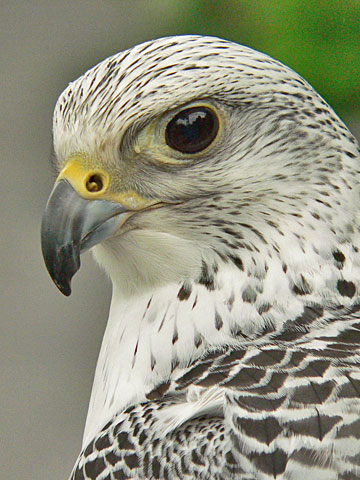
Gyrfalcon


The gyrfalcon is the largest of all falcon species.
The Gyrfalcon breeds on Arctic coasts and islands of North America, Europe and Asia.
It is mainly resident, but some Gyrfalcons disperse more widely
after the breeding season, or in winter .
Its scientific name is composed of the Latin terms for a falcon, Falco, and for
someone who lives in the countryside, rusticolus.
This species is a very large falcon, about the same size as the largest buteos.
Males are 48 to 61 cm long, weigh 805 to 1350 g
and have a wingspan from 110 to 130 cm (43 to 51 in).
Females are rather bulkier and larger at 51 to 65 cm (20 to 26 in) long,
a weight of 1180 to 2100 g (2.6 to 4.6 lbs) and have a wingspan ranging from 124 to 160 cm .
In dimensions, gyrfalcons lie between
a large Peregrine Falcon and a hawk in general structure; they are unmistakably falcons with pointed wings, but are stockier, broader-winged, and longer-tailed than the Peregrine.

Monday, November 2, 2009

Falcon fly


Falcon fly

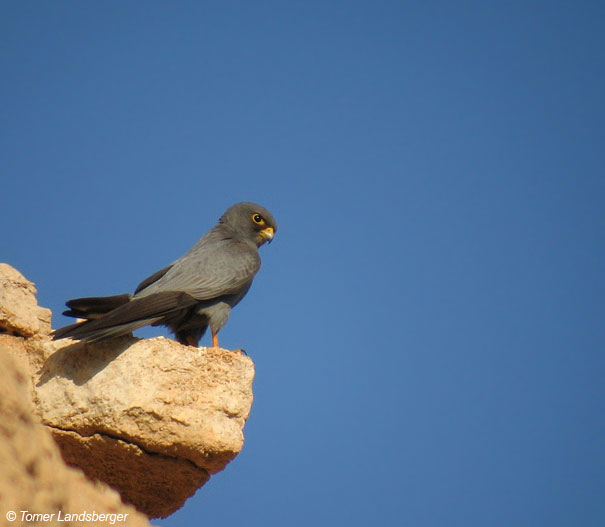
Falco concolor


The Sooty Falcon (Falco concolor ) is a medium-sized falcon breeding from northeastern Africa to the southern Persian Gulf region.
It belongs to the hobby group, a rather close-knit number of similar falcons often considered a subgenus Hypotriorchis.
Eleonora's Falcon is sometimes considered its closest relative
but while they certainly belong to the same lineage, they do not seem
to be close sister species.

Sunday, November 1, 2009

Falco dickinsoni


Dickinson's Kestrel (Falco dickinsoni) is a bird of prey of southern and eastern Africa belonging to the falcon family Falconidae. It is named after John Dickinson, an English physician and missionary who collected the type specimen.
It is also known as the White-rumped Kestrel.
Its closest relatives are the Grey Kestrel and Banded Kestrel and the three
are sometimes placed in the subgenus Dissodectes.
It inhabits savanna and open woodland, particularly swampy areas near water.
It is typically associated with palm trees and is also often found near baobab trees.
It occurs in coconut plantations in some areas.
Its range covers most of Mozambique, Zimbabwe, Zambia and Malawi along with north-eastern South Africa (mainly in Kruger National Park), northern Botswana, north-east Namibia, eastern Angola, southern Democratic Republic of the Congo and parts of Tanzania.
It is an occasional visitor to Kenya.
The total range is about 3.4 million km2. It is generally rather scarce but is commoner in some areas such as Zanzibar and
Pemba Islands. Loss of palm trees is a potential threat to the species.

Falco ardosiaceus


The Grey Kestrel (Falco ardosiaceus) is an African bird of prey belonging to the falcon family Falconidae.
Its closest relatives are the Banded Kestrel and Dickinson's
Kestrel and the three are sometimes placed in the subgenus Dissodectes.
It inhabits savannas, open woodland and forest clearings.
It favours areas with palm trees, especially near water.
It often perches on exposed branches, telegraph poles and wires.
It is widespread in West and Central Africa but is absent from densely forested regions including parts of the Congo Basin. Its range extends east to Ethiopia and western parts of Kenya and Tanzania.
In the south it reaches northern parts of Namibia and Zambia and vagrants have appeared in Malawi.
The total range covers about 12 million km². In West Africa there is some movement northward in the wet season and southward in the dry season.