Showing posts with label Falco rupicoloides. Show all posts

Sunday, November 29, 2009

Paris History - part 2


-Around 250 A.D.: Lutetia is christianized. The first churches are built.
- 4th-9th centuries: Frankish and Norman invasions.
Clovis I pronounces the kingdom of Gaul and renames Lutetia Paris.
-1163: Construction of the Notre Dame Cathedral begins.
It would take almost two centuries to complete the masterpiece of early gothic architecture.
- 12th and 13th century: Other important monuments and sites are built, including the Sorbonne and the Sainte-Chapelle cathedral.
The swamp (Marais) on the right bank of the Seine is drained and the city expands north of the Seine. Around 1200, construction of a fortress that

Saturday, November 21, 2009

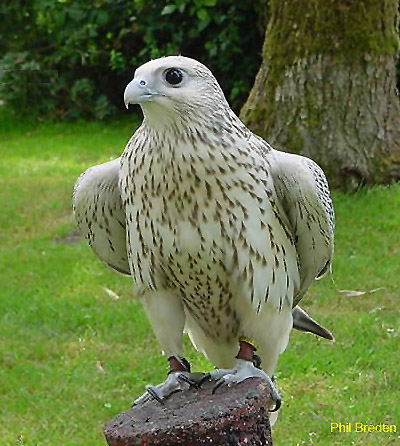
The Gyrfalcon


The Gyrfalcon eats mostly ptarmigan, but many other prey species have been recorded
including fulmars, gulls, jaegers, ducks, geese, Rough-legged Hawk, Short-eared Owl, sparrows, buntings, and redpolls.
The female Gyrfalcon regularly stores prey during the breeding season, generally within 100 meters (328 feet) of the nest.
Little is known of food-caching outside the breeding season; in one case, a Gyrfalcon was seen retrieving a frozen ptarmigan and chipping
off pieces of meat to eat, in mid-winter in the Aleutian Islands.
Gyrfalcon is pronounced as "JER-falcon." The name probably evolved from
Old Norse, but linguists do not completely agree on the specific origin of the word.
The Gyrfalcon sometimes bathes in runoff water of still-frozen rivers.
Mostly birds, especially ptarmigan. Also consumes mammals, ranging in size from voles to hares.

falcon - stamps


falcon stamps

Sunday, November 1, 2009

Falco ardosiaceus


The Grey Kestrel (Falco ardosiaceus) is an African bird of prey belonging to the falcon family Falconidae.
Its closest relatives are the Banded Kestrel and Dickinson's
Kestrel and the three are sometimes placed in the subgenus Dissodectes.
It inhabits savannas, open woodland and forest clearings.
It favours areas with palm trees, especially near water.
It often perches on exposed branches, telegraph poles and wires.
It is widespread in West and Central Africa but is absent from densely forested regions including parts of the Congo Basin. Its range extends east to Ethiopia and western parts of Kenya and Tanzania.
In the south it reaches northern parts of Namibia and Zambia and vagrants have appeared in Malawi.
The total range covers about 12 million km². In West Africa there is some movement northward in the wet season and southward in the dry season.

Falco rupicoloides


The Greater Kestrel or White-eyed Kestrel (Falco rupicoloides) is a bird of prey belonging to the falcon family Falconidae.
It is one of the largest kestrels and is found in open country in southern and eastern Africa.
It occurs in open, arid areas where it inhabits grassland, savannas and semi-desert.
It is often associated with acacias.
It prefers areas where the ground cover is lower than 50 cm.
It is found from sea-level up to 2 150 metres, particularly between 800 and 1800 metres.
It is fairly common and widespread in the southern parts of its range but is scarce and patchily distributed further north.
The form F. r. rupicoloides breeds in Namibia, Botswana, Zimbabwe, parts of Angola and Zambia and in much of South Africa apart from the wetter regions
of the south and east. F. r. arthuri is found in Kenya and northern
Tanzania while F. r. fieldi occurs in Ethiopia, Eritrea, northern Somalia and probably northern Kenya.
The total range covers about 3.5 million km2.
The population is stable and is likely to be in the order of 100 000 to 200 000 pairs.
Most birds are sedentary but some are nomadic or dispersive.