Showing posts with label Bears. Show all posts

Sunday, November 29, 2009

Paris History - part 5


- 1799: A revolutionary general named Napoleon Bonaparte stabilizes the unruly government.
He becomes Emperor in 1804.
His emperorship puts a hiatus on France's struggle toward a Republic-- this is well-symbolized by Napoleon's moving into the former royal seat of power at Versailles.
The Emperor's taste for power and conquest lead to the colonization of large swathes of North Africa. He is defeated at Waterloo in 1815.
-Mid-19th century: The Paris that still largely remains today is constructed by Baron Haussmann, under the direction of Napoleon III.
Wide boulevards and a sewer system replace most of the narrow, cramped medieval and Renaissance-era streets of the city.
-1870: Following a disastrous war with the Prussians, the third Republic
is declared, marking the beginning of democratic institutions in France.
The Belle Epoque opens, another artistically and culturally fertile time in Paris history. Art nouveau architecture and artistic movements like impressionism take the world by storm.
-1920's and 1930's: Paris is one of the world's most important hotbeds of experimentation in art and literature. Salvador Dali, Pablo Picasso
and the "Lost Generation" of English-speaking writers like Ernest Hemingway, James Joyce, James Baldwin, Gertrude Stein, and Ezra Pound make Paris their home.

Saturday, November 21, 2009

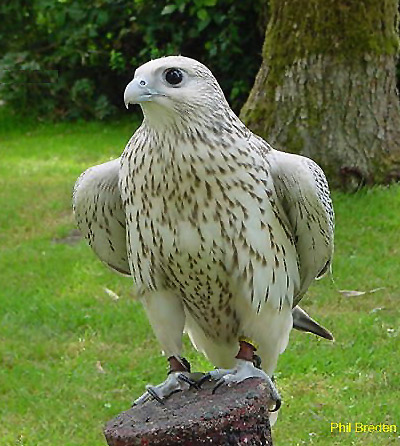
The Gyrfalcon


The Gyrfalcon eats mostly ptarmigan, but many other prey species have been recorded
including fulmars, gulls, jaegers, ducks, geese, Rough-legged Hawk, Short-eared Owl, sparrows, buntings, and redpolls.
The female Gyrfalcon regularly stores prey during the breeding season, generally within 100 meters (328 feet) of the nest.
Little is known of food-caching outside the breeding season; in one case, a Gyrfalcon was seen retrieving a frozen ptarmigan and chipping
off pieces of meat to eat, in mid-winter in the Aleutian Islands.
Gyrfalcon is pronounced as "JER-falcon." The name probably evolved from
Old Norse, but linguists do not completely agree on the specific origin of the word.
The Gyrfalcon sometimes bathes in runoff water of still-frozen rivers.
Mostly birds, especially ptarmigan. Also consumes mammals, ranging in size from voles to hares.

Thursday, October 22, 2009

Brown Bear


The brown bear, also known as a grizzly in North America
is like the bears in Brother Bear.
They are large and are usually a dark brown
but can be a creamy shade or black.
They have long claws on their front paws and have a hump on their shoulders.
Their weight depends on the food available and it is a fact that bears can weigh twice as much in the autumn than in the spring.
The male adults weigh 135 kilograms to 390 kilograms. Cubs at birth weigh 340 to 680 grams.
Brown bears occupy a wide range of places like in eastern and western Europe, Northern Asia, Japan, Northern America, western Canada, Alaska, Wyoming, Montana, Idaho and Washington in forest areas
and central plains in mountains and tundra.
Grizzly catching salmon in riverDiet
Brown bears eat mainly vegetation in spring but like
salmon in summer and autumn and would hibernate in winter.
The vegetation they eat is grass, sedge, bulbs and roots.
In some places they also hunt moose, caribou and elk.
Grizzly with cub
The cubs are born from January to March and remain with their mums for two and a half years. They can have one to four cubs, but twins are the most common

Asiatic Black Bear - wallpaper


Asiatic Black Bear - wallpaper

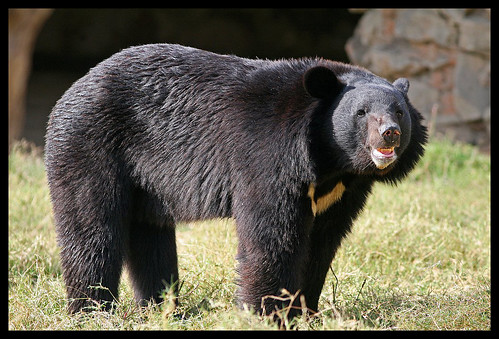
Asiatic Black Bear


Asiatic black bears are medium sized
black bears with a distinct white patch on their chests
and have a white spot on their chins. Because of this on their chests people in Asia sometimes
call them Moon bears.
Their ears are good to help them be spotted (it helped me and
my mum work out who was who) because they are bigger than any other bears ears.
Size
They grow to 130 to 190 centimetres long and can weigh 100 to 200 kilograms.
The females are a lot smaller.
They live in forested areas and hill spots of southern Asia Afghanistan, Pakistan, northern India, Nepal, Sikkim, Bhutan, Burma, north-eastern China, south-eastern Russia, Taiwan, and on the Japanese islands of Shikoku and Honshu.
They probably don’t hibernate at winter time.
The cubs are born at different times of the year in different countries. They stay with their mums for two or three years. Sometimes the mother bears can be seen with cubs of different ages.
Asiatic black bears like to eat fruits, berries, insects, invertebrates
and small vertebrates and carrion.

Polar bear fur


There’s this myth floating around that polar bear fur is fiber optic.
It’s not. It’s not it’s not it’s not.
The myth goes like this
polar bears are white, but they have to keep warm in the winter.
But white reflects light and heat, so how do they do it?
By having fiber optic fur.
“Fiber optics” are a type of “light pipe” that channels light extraordinarily well, sort of like an electric wire does for electric current.
So, this is supposed to heat them up by channeling light to their black skin.
This is based on research that showed that polar bears are
white to you and me, but don’t emit any ultraviolet (UV) light (they’re black in the ultraviolet).
They thought the UV radiation was being absorbed by fiber optics and transported to the skin. It turns out instead that polar bear
fur just absorbs UV on its own because of what it’s made of.
So this is an example of an early, incorrect science report getting circulated and taking hold in the popular mind.
This myth gets perpetuated by the fact that polar bear fur is hollow.
Fiber optics are also hollow, but not every hollow thing is a fiber optic (this is like the “a square is a rectangle but a rectangle isn’t always a square” thing).

Polar Bear - wallpaper


Polar Bear - wallpaper

Polar Bear


Polar bears are immediately recognisable because of their distinctive white colour of fur. They have a longer head and neck than all
the other bears but have quite small ears.
They have very big front paws, which are great for swimming.
Their feet have special skin underneath which helps them
walk on ice without slipping.
Polar bear walking across iceSize
Polar bears are the world’s biggest carnivore.
The adult males can grow to more
than 800 kilograms. Wow, that’s big! Females are about half the size
of the males and are 190 to 200 centimetres long.
The males are about 250 centimetres long.
Cubs weigh 600 to 700 grams when they are born
Polar bears live on the ice that floats on the sea in the Arctic Circle, although they can be found quite far south in Canada.
Polar bear with cubCubs
Polar bears usually give birth to two cubs (twins) in winter.
The babies stay with their mum for two and a half years.
They normally only give birth every three years
Polar bears like to eat seals, although in the summer time
some berries and grass. They are the most carnivorous of all the bears.
There used to be a polar bear at Belfast Zoo
but it was unhappy so they sent it to another zoo, where they thought
it would have a better life.

Sloth Bear - photo


Sloth Bear - photo

Sloth Bear


Sloth bears are quite small with long shaggy fur, which is usually black.
Their nose is much lighter in colour and their nostrils can be closed or open.
They have a distinctive chest patch, which is white or yellow fur in a U or Y shape.
Adults are around 150 to 190 centimetres long.
Males are bigger than the females and they weigh 80 to 140 kilograms but females only weigh 55 to 95 kilograms Wow!
Sloth bears are mostly found in India and Sri Lanka, but can be found in Bangladesh, Nepal and Bhutan.
They live in forests and grassland.
They don’t like to live in wet places.
Sloth bears love eating termites.
They have a special gap in their teeth to suck them up.
They can stick out their lips to make a straw and you can hear the noise from over 100 metres awaySloth bear with cubs
They have their babies in winter.
One or two are born in a special den and their mums stay in
there with them for two or three months

Sun Bear - wallpaper


Sun Bear - wallpaper

Types of Bears


There are eight different types of bear.
They are:-

Giant Panda
Sun Bear

Spectacled
Bear
Sloth bear
Polar Bear
Asiatic Black Bear
American Black Bear
Brown Bear