Showing posts with label Asiatic Black Bear. Show all posts

Friday, November 27, 2009

Chantilly - north of France


From the 10th to the 14th century, Chantilly belonged to the Lords of Senlis that built the first castle which there are no remains today. Between 1386 and 1394, Pierre dÍOrgemont built a medieval fortress. The only remains today are the tower foundations in the moat.

Sunday, November 22, 2009

polyborus plancus


MEASUREMENTS: The Crested Caracara has a body length of 19 - 23 inches, a 4-foot wingspan, and weighs 1 3/4 - 3 1/2 pounds.
The bird’s weight varies greatly depending on where it lives.
HABITAT: The Crested Caracaras’ preferred habitat is open, lowland countryside, like pastures, savannas, river edges, and ranches.
They may also be found in some forests and marshes.
These birds reside in the southwestern United States and Florida, Central America, and South America.
DIET: The Crested Caracara usually feeds on carrion, but they will take advantage of any food opportunity by eating small mammals, amphibians, reptiles, turtles, fish, crab, eggs, insects, worms, and nestling birds.
Caracaras hunt live food on the ground or take food from other birds.
REPRODUCTION: Crested Caracaras build a massive stick nest in a palm, cactus, tree, or on the ground. The female usually lays 2 - 3 eggs
that are incubated for 28 - 32 days. The young caracaras have a drawn out fledging period, taking up to 3 months before they are flying as independent birds.
NAME DERIVATION: The scientific name comes from poly, the Greek word for many or varied; boros, meaning gluttonous and remarks on the bird’s voracious appetite; and from the Latin word plancus, which is a word Aristotle used for an eagle.
The common name, caracara, is what South Americans called the bird and probably imitates the sound of the bird.
This bird has been called Caracara Eagle, King Buzzard, Mexican Eagle, Audubon’s Caracara
and Mexican Buzzard.
The scientific name of this bird was formerly Caracara cheriway.
INTERESTING FACTS:
-Unlike other members of the falcon family that do
not construct nests, the caracara builds a stick nest.
-The caracara is the most terrestrial bird in the falcon group.
It spends a great deal of time on the ground.

Saturday, October 31, 2009

falcon - facts


AT RIGHTaround forty days, young Peregrines begin flying. Peregrine parents encourage flight by "baiting" the young with food, which is no longer neatly prepared and fed directly to the young. It is a lot of fun to watch young Peregrines chasing each other and everything else!
As in many other species, Peregrine young learn in part through "playing" - however, this play can be deadly serious when hunting is involved.
Peregrines hunt and eat other birds and are famed
for their speed (stooping, or diving, Peregrines
have been clocked at speeds of up to 220mph) and aerial prowess.
Here are some bird
fact sheets from one of my OTHER favorite web sites, the Animal Diversity Web

Friday, October 30, 2009

Puna Flamingo


Latin Name Phoenicoparrus jamesi
Location South America
Colour Pinkish/White
Height Up to 1 m (3.25 ft)
Wingspan Approx. 1 m (3.25 ft)
Weight Up to 2 Kgs (4.5 lbs)
Life Expectancy Up to 40 Yrs
Puna Flamingos are one of three species of South American flamingo, the other two being the Andean Flamingo and the Chilean Flamingo.
They stand at heights up to 1 m (3.25 ft), they have a wingspan of approximately 1 m (3.25 ft) and they weigh up to 2 kgs (4.5 lbs).
They have pinkish white plumage with dark pink streaks on their back and at the base of their neck. As young birds they are grey in colour
but their plumage slowly turns pink as they mature.
They have a long neck and long, thin, dark red legs. Their downward curving beak is yellow in colour with a black tip.
Puna Flamingos have a loud honking call that is similar to that of a goose and they are unmistakable in flight with their long,
thin neck outstretched in front and their long legs outstretched behind them.
Habitat
Puna Flamingos inhabit the salt lakes and lagoons of the Andes mountains.
They can be found together with
Andean Flamingos and Chilean Flamingos usually at altitudes of over 3,000 m (9,900 ft). During the winter they migrate
to lower altitudes but some remain at lakes where there are hot springs.
Diet
Puna Flamingos feed on diatoms such as algae.
They feed during the day in shallow water, walking slowly forwards
with their bill dipped just below the surface.
They are filter feeders and they use their specially adapted
beak and tongue to filter food from the water.
Breeding
Puna Flamingos nest in colonies containing thousands of pairs.
They produce one chalky white egg that is laid on a mud mound in shallow water. Both parents incubate the egg which takes 27 - 31 days to hatch.
They will defend their nest during the breeding season, otherwise they are non-territorial.
After the chick first hatches they
are fed a substance called "crop milk" which comes from the parents' upper digestive tract. Either parent can feed the chick this way and other
flamingos can act as foster feeders. When the chicks are old enough to walk they gather together in creches that are watched over by a few adult birds.
By the time young flamingos reach 2 - 3 years of age they will have gained their full adult plumage.
Predators
Egg collection and hunting were major threats to Puna Flamingos up until 1986.
Guards are now employed to protect these flamingos at one of their major breeding sites.
Interesting Facts
The Puna Flamingo is also known as:
James's Flamingo
It was named after Harry Berkeley James.
It derives its common name from its habitat - "puna" is the
local word for high Andean plateau.
The Puna Flamingo is closely related to the Andean Flamingo.
Flamingo comes from the latin word for flame.
The flamingo's characteristic pink colouring
is caused by the beta carotene in their diet.

Greater Flamingo


Latin Name Phoenicopterus roseus
Location C & S America, Caribbean, SW Europe, Asia & Africa
Colour Pinkish/White
Height 1.5 m (5 ft)
Wingspan 1.4 - 1.7 m (4.5 - 5.5 ft)
Weight Up to 4 Kgs (8.75 lbs)
Life Expectancy Up to 40 Yrs
Main Characteristics
Greater Flamingos are the largest member of the
flamingo family and they are the most widespread.
They stand at 1.5 m (5 ft) tall, they have a wingspan between 1.4 and 1.7 m (4.5 - 5.5 ft) and they weigh up to 4 Kgs (8.75 lbs).
They are pinkish white in colour but immature
birds are grey before they get their full adult plumage.
They have long, pink legs with relatively small webbed feet, and a very long neck.
Their large bill is downward curving and
it is pink in colour with a black tip.
They have narrow wings with their primary
and secondary flight feathers being black in colour and their wing coverts being red.
Greater Flamingos are unmistakable in flight with their long
thin neck outstretched in front and their long legs outstretched behind them.
Flocks form either long, trailing lines or irregular shapes whilst in flight.
Greater Flamingos have a loud, deep honking call that is similar to that of a goose.
They call loudly during courtship but they have a quieter call while they are feeding.
Habitat
Greater Flamingos are found in both
freshwater and saltwater habitats of Central and South America
the Caribbean, south west Europe, Asia and Africa.
They live on lakes, estuaries and lagoons and Greater Flamingos that live outside the tropics often migrate to warmer climates for the winter months.
They live in colonies but these range vastly in size.
They can consist of thousands of birds, but in some areas such
as the Galapagos Islands, they may only consist of a few dozen birds.
Diet
Greater Flamingos feed upon insects, worms, vegetation and algae.
They mainly feed during the day and they sweep their bill upside
down through shallow water picking up food as they go.
They usually feed with their head fully immersed
in water and they can remain that way for up to 20 seconds.
They are filter feeders and their tongue pumps up and down, 5 - 6 times per second, pushing the water out of their beak.
Unlike smaller flamingos the Greater
Flamingo rarely takes food from the surface of the water and because of its size it is able to wade out into deeper water to feed.
Also they sometimes swim, upending like a duck to reach food.
Breeding
Greater Flamingos breed in colonies of up to 200,000
monogamous pairs and after courtship rituals of synchronized dancing, preening, neck stretching and honking they mate during April and May.
They produce one chalky white egg that is laid on a mud mound in shallow water. The nest of each pair is situated approximately 1.5 m (4.9 ft) from neighbouring nests so the chick remains safe from other breeding pairs.
Both parents incubate the egg which takes 27 - 31 days to hatch.
They will defend their nest during the breeding season, otherwise they are non-territorial.
After the chick first hatches they are fed a substance called "crop milk" which comes from the parents' upper digestive tract.
Either parent can feed the chick this way and other flamingos can act as foster feeders.
When the chicks are old enough to walk they
gather together in creches that are watched over by a few adult birds.
By the time young flamingos reach 2 - 3 years of
age they will have gained their full adult plumage.
Predators
Greater Flamingos have few natural predators
however their eggs and chicks are preyed upon
by other birds including the marabou stork.
Interesting Facts
Greater Flamingos are closely related to the Caribbean
Flamingo and the Chilean Flamingo.
Flamingo comes from the latin word for flame.
The flamingo's characteristic pink colouring
is caused by the beta carotene in their diet.

Thursday, October 22, 2009

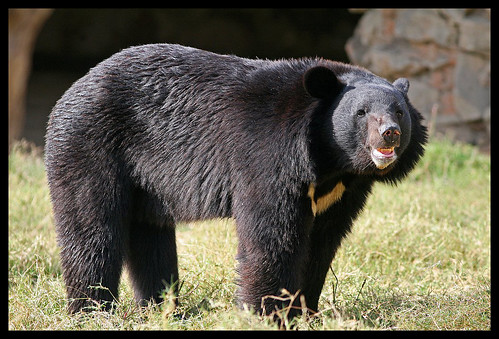
Asiatic Black Bear - wallpaper


Asiatic Black Bear - wallpaper

Asiatic Black Bear


Asiatic black bears are medium sized
black bears with a distinct white patch on their chests
and have a white spot on their chins. Because of this on their chests people in Asia sometimes
call them Moon bears.
Their ears are good to help them be spotted (it helped me and
my mum work out who was who) because they are bigger than any other bears ears.
Size
They grow to 130 to 190 centimetres long and can weigh 100 to 200 kilograms.
The females are a lot smaller.
They live in forested areas and hill spots of southern Asia Afghanistan, Pakistan, northern India, Nepal, Sikkim, Bhutan, Burma, north-eastern China, south-eastern Russia, Taiwan, and on the Japanese islands of Shikoku and Honshu.
They probably don’t hibernate at winter time.
The cubs are born at different times of the year in different countries. They stay with their mums for two or three years. Sometimes the mother bears can be seen with cubs of different ages.
Asiatic black bears like to eat fruits, berries, insects, invertebrates
and small vertebrates and carrion.