Showing posts with label drawing. Show all posts

Saturday, January 9, 2010

The Nursing of Saint Sebastian - Dirk van Baburen


Dirck Van Baburen
The Nursing of Saint Sebastian - 1622

Tuesday, December 8, 2009

Portrait of Ginevra de'Benci


Portrait of Ginevra de'Benci
Leonardo da Vinci
1478-1480
Oil and tempera on wood
National Gallery
of Art,Washington DC

Sunday, November 29, 2009

Paris History - part 4


- 1643: At age 5, Louis XIV, also known as the Sun King, becomes king of France. His reign introduces a period of major prosperity-- not to mention decadence. The King builds Versailles in 1623, displacing the center of power from the Palais Royal in central Paris to the countryside.

- 1774: Louis XVI ascends to the throne.
Known for his political and social ineptitude and his curious fixation with locks and clocks
he is married to Marie Antoinette, the adolescent daughter of powerful Austrian empress Maria Theresa.
- July 14, 1789: The Bastille prison in Paris is stormed and burned to rubble, marking the beginning of the French Revolution.
Louis XVI and Marie Antoinette are widely accused of rampant
decadence and indifference to the plight of the people.
- 1792: Fall of the monarchy and declaration of the first French republic.
In 1793, Louis XVI and Marie Antoinette are guillotined.
- 1793-1799: The Revolutionary "reign of terror" leads to thousands of executions and general chaos, and Paris is the center of it.
Religion is banned and a new calendar is established.

Sunday, November 22, 2009

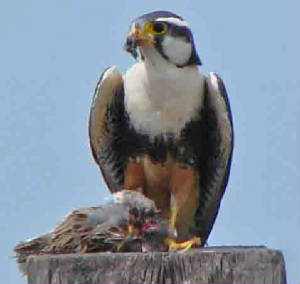
polyborus plancus


MEASUREMENTS: The Crested Caracara has a body length of 19 - 23 inches, a 4-foot wingspan, and weighs 1 3/4 - 3 1/2 pounds.
The bird’s weight varies greatly depending on where it lives.
HABITAT: The Crested Caracaras’ preferred habitat is open, lowland countryside, like pastures, savannas, river edges, and ranches.
They may also be found in some forests and marshes.
These birds reside in the southwestern United States and Florida, Central America, and South America.
DIET: The Crested Caracara usually feeds on carrion, but they will take advantage of any food opportunity by eating small mammals, amphibians, reptiles, turtles, fish, crab, eggs, insects, worms, and nestling birds.
Caracaras hunt live food on the ground or take food from other birds.
REPRODUCTION: Crested Caracaras build a massive stick nest in a palm, cactus, tree, or on the ground. The female usually lays 2 - 3 eggs
that are incubated for 28 - 32 days. The young caracaras have a drawn out fledging period, taking up to 3 months before they are flying as independent birds.
NAME DERIVATION: The scientific name comes from poly, the Greek word for many or varied; boros, meaning gluttonous and remarks on the bird’s voracious appetite; and from the Latin word plancus, which is a word Aristotle used for an eagle.
The common name, caracara, is what South Americans called the bird and probably imitates the sound of the bird.
This bird has been called Caracara Eagle, King Buzzard, Mexican Eagle, Audubon’s Caracara
and Mexican Buzzard.
The scientific name of this bird was formerly Caracara cheriway.
INTERESTING FACTS:
-Unlike other members of the falcon family that do
not construct nests, the caracara builds a stick nest.
-The caracara is the most terrestrial bird in the falcon group.
It spends a great deal of time on the ground.

Saturday, October 31, 2009

Friday, October 30, 2009

Puna Flamingo


Latin Name Phoenicoparrus jamesi
Location South America
Colour Pinkish/White
Height Up to 1 m (3.25 ft)
Wingspan Approx. 1 m (3.25 ft)
Weight Up to 2 Kgs (4.5 lbs)
Life Expectancy Up to 40 Yrs
Puna Flamingos are one of three species of South American flamingo, the other two being the Andean Flamingo and the Chilean Flamingo.
They stand at heights up to 1 m (3.25 ft), they have a wingspan of approximately 1 m (3.25 ft) and they weigh up to 2 kgs (4.5 lbs).
They have pinkish white plumage with dark pink streaks on their back and at the base of their neck. As young birds they are grey in colour
but their plumage slowly turns pink as they mature.
They have a long neck and long, thin, dark red legs. Their downward curving beak is yellow in colour with a black tip.
Puna Flamingos have a loud honking call that is similar to that of a goose and they are unmistakable in flight with their long,
thin neck outstretched in front and their long legs outstretched behind them.
Habitat
Puna Flamingos inhabit the salt lakes and lagoons of the Andes mountains.
They can be found together with
Andean Flamingos and Chilean Flamingos usually at altitudes of over 3,000 m (9,900 ft). During the winter they migrate
to lower altitudes but some remain at lakes where there are hot springs.
Diet
Puna Flamingos feed on diatoms such as algae.
They feed during the day in shallow water, walking slowly forwards
with their bill dipped just below the surface.
They are filter feeders and they use their specially adapted
beak and tongue to filter food from the water.
Breeding
Puna Flamingos nest in colonies containing thousands of pairs.
They produce one chalky white egg that is laid on a mud mound in shallow water. Both parents incubate the egg which takes 27 - 31 days to hatch.
They will defend their nest during the breeding season, otherwise they are non-territorial.
After the chick first hatches they
are fed a substance called "crop milk" which comes from the parents' upper digestive tract. Either parent can feed the chick this way and other
flamingos can act as foster feeders. When the chicks are old enough to walk they gather together in creches that are watched over by a few adult birds.
By the time young flamingos reach 2 - 3 years of age they will have gained their full adult plumage.
Predators
Egg collection and hunting were major threats to Puna Flamingos up until 1986.
Guards are now employed to protect these flamingos at one of their major breeding sites.
Interesting Facts
The Puna Flamingo is also known as:
James's Flamingo
It was named after Harry Berkeley James.
It derives its common name from its habitat - "puna" is the
local word for high Andean plateau.
The Puna Flamingo is closely related to the Andean Flamingo.
Flamingo comes from the latin word for flame.
The flamingo's characteristic pink colouring
is caused by the beta carotene in their diet.

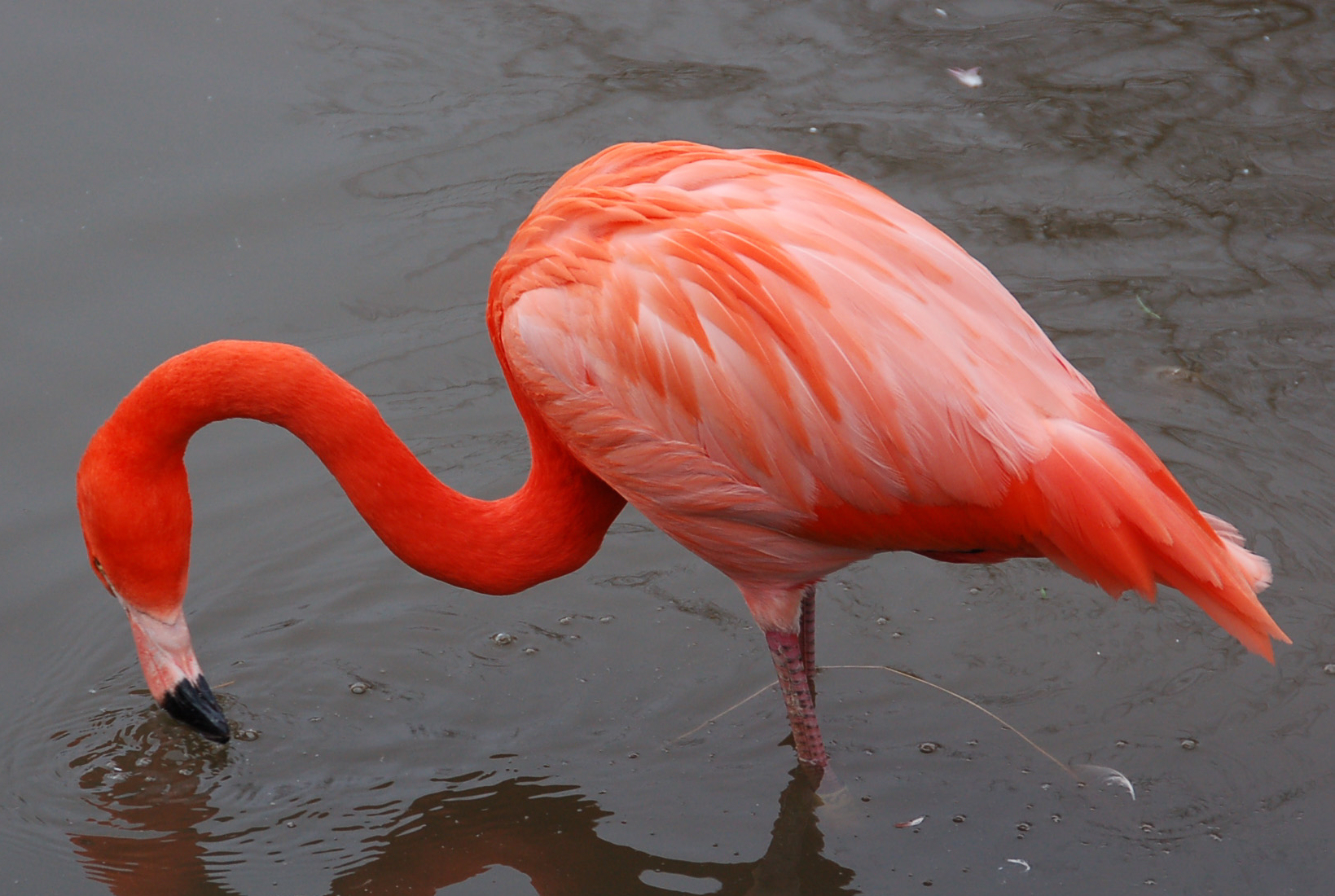
Caribbean Flamingo


Latin Name Phoenicopterus ruber
Location Caribbean, Yucatan Peninsula, Galapagos Islands
Colour Pink/Red/Orange
Height 1.2 - 1.4 m (3.9 - 4.6 ft)
Wingspan Approx. 1.5 m (4.9 ft)
Weight 2.2 - 2.8 Kgs (4.9 - 6.2 lb)
Life Expectancy Up to 40 Yrs (in captivity)
Main Characteristics
Caribbean Flamingos are the only flamingo to naturally inhabit North America.
They stand between 1.2 and 1.4 m (3.9 - 4.6 ft) in height, they have a wingspan of approximately 1.5 m (4.9 ft) and they weigh between 2.2 and 2.8 kgs (4.9 - 6.2 lbs).
They are deep pink/red/orange in colour and
they have the brightest plumage of all flamingo species.
As young birds they are grey in colour but their plumage slowly
turns pink as they mature.
They have long, pink legs with their knees being a slightly darker pink.
Their large bill is downward curving and it is pink in colour with a black tip.
They have narrow wings with their primary
and secondary flight feathers being black in colour and their wing coverts being red.
Caribbean Flamingos have a loud, deep honking call that is similar
to that of a goose. They call loudly during courtship
but they have a quieter call while they are feeding.
Habitat
Caribbean Flamingos are found in the lagoons, mudflats and lakes of the Caribbean, the Yucatan Peninsula and the Galapagos Islands.
They are highly social birds and they live in colonies
that can contain thousands of individuals.
Diet
Caribbean Flamingos feed upon insects, worms, vegetation and algae.
They mainly feed during the day and they sweep their
bill upside down through shallow water picking up food as they go.
They are filter feeders and their tongue
pumps up and down, 5 - 6 times per second, pushing the water out of their beak.
Breeding
Caribbean Flamingos breed in colonies that can contain thousands of individuals and after courtship rituals of synchronized dancing, preening, neck stretching
and honking they mate during April and May.
They produce one chalky white egg that is laid on a mud mound in shallow water.
The nest of each pair is situated approximately 1.5 m (4.9 ft) from neighbouring nests so the chick remains safe from other breeding pairs.
Both parents incubate the egg which takes 27 - 31 days to hatch.
They will defend their nest during the breeding season, otherwise they are non-territorial.
After the chick first hatches they are fed a substance called "crop milk" which comes from the parents' upper digestive tract. Either parent can feed
the chick this way and other flamingos can act as foster feeders.
When the chicks are old enough to walk they gather
together in creches that are watched over by a few adult birds.
By the time young flamingos reach 3 - 5 years of age
they will have reached sexual maturity and gained their full adult plumage.
Predators
The main predators of Caribbean Flamingos
are jaguars, raccoons, birds of prey, margay and humans .
Interesting Facts
Caribbean Flamingos are closely related to the Greater Flamingo and the Chilean Flamingo.
Caribbean Flamingos are also known as:
Rosy Flamingo
American Flamingo
Flamingo comes from the latin word for flame.
The global population of Caribbean
Flamingos is estimated to be between 850,000 and 880,000 individuals.
The flamingo's characteristic pink colouring
is caused by the beta carotene in their diet.

Andean Flamingo


Latin Name Phoenicoparrus andinus
Location South America
Colour Pinkish/White
Height 1 - 1.4 m (3.25 - 4.60 ft)
Wingspan 1 - 1.6 m (3.25 - 5.25 ft)
Weight Up to 4 Kgs (8.8 lbs)
Life Expectancy Up to 40 Yrs
Main Characteristics
Andean flamingos reach heights between 1 and 1.4 m (3.25 - 4.60 ft)
they have a wingspan between 1 and 1.6 m (3.25 - 5.25 ft) and they weigh up to 4 kgs (8.8 lbs).
They are light pink in colour with their head, neck and upper breast being darker.
As young birds they are grey
in colour but their plumage slowly turns pink as they mature.
Their long, thin legs and feet are yellow in colour and their large, downward curving bill is yellow with an extensive black tip.
Andean Flamingos have a loud honking
call that is similar to that of a goose they also communicate
using a wing salute, stretching up their neck and flipping up their tail.
Habitat
Andean Flamingos are found in the lakes and lagoons of the Andes mountains.
They are highly gregarious birds and form flocks containing thousands of individuals.
Diet
Andean Flamingos are filter feeders and they mainly
feed upon diatoms and algae.
Breeding
Andean Flamingos breed in colonies containing thousands of individuals, during December and January. They produce one chalky white
egg that is laid on a mud mound in shallow water. Both parents incubate
the egg which takes 27 - 31 days to hatch.
Upon hatching the chicks are covered in white/grey down feathers and
they are fed a substance called "crop milk" which comes from the parents' upper digestive tract. Either parent can feed the chick this way
and other flamingos can act as foster feeders.
When the chicks are old enough to walk they
gather together in creches that are watched over by a few adult birds.
By the time young flamingos reach 6 - 10 months old they
are ready to fend for themselves and at 3 - 6 years old
they will have reached sexual maturity and gained their full adult plumage.
Predators
Andean Flamingos do not have many predators.
Chicks are preyed upon by culpeo foxes and birds of prey.
Interesting Facts
The Andean Flamingo is closely related to the Puna Flamingo.
Flamingo comes from the latin word for flame.
The flamingo's characteristic pink colouring
is caused by the beta carotene in their diet.

CHILEAN FLAMINGO


location: South America
Habitat: Shallow, salty lakes and lagoons
Chilean flamingos stand four to five feet tall and can weigh anywhere from 13-16 pounds. They have a long neck and long, slender legs.
Their bill is bent downward in the middle.
Most of their body is coverd in pale pink feathers with darker pink and black wings.
Their legs are dull yellow or yellow-gray with dark pink bands at the joints and pink feet.
Flamingos will lock their “knees” (which are really their ankles) and stand on one leg. Standing in this manner helps them to conserve heat.
They typically will stand facing into the wind or rain so that
the water does not get into their feathers.
They have an excellent sense of hearing, but a very poor sense of smell.
These birds are social, usually living in flocks numbering in the thousands.
When in these large groups, they can be quite loud while making their deep, honking noises along with other vocalizations, such as grunting and howling.
They do everything in these groups including breeding, feeding and flying.
The large group is also their main defense.
Having so many individuals increases the possibility of predator sightings, but decreases the probability of an individual becoming prey.
Their main predators are humans and gulls, which eat their eggs.
Flamingos are filter feeders, eating aquatic invertebrates, seeds and algae from shallow water and mud.
They walk along the bottom of the lake kicking up the mud with their feet.
Water is sucked into their beak.
As their tongue pushes the water out, it is filtered through a row of spines, or lamellae, along the edge of the bill, which traps the food.
The pink coloration comes from pigments, called caretonoids, in the tiny animals they eat. In most captive populations, this pink color must be artificially added to the diet.
The courtship displays are quite elaborate.
The males and females will perform a number of head and wing movements which look similar to everyday preening, but are much more rigid.
Flamingos make their nests out of mud by piling the mud and forming it into a large mound about 15 inches in diameter and 1 ½ -2 feet tall.
The female makes an indentation on the top where she will lay her egg. Incubation lasts 27-31 days, and both the mother and father sit on the egg. When it hatches, the chick is covered with gray downy feathers.
Their beaks are straight at birth so that they can be fed by regurgitation from their parents. After a few months the beak curves.
They grow in their adult plumage after about two years.
They become sexually mature at 6 years of age. The typical lifespan in the wild is up to 50 years.
The Chilean Flamingo is listed on the Convention on International Trade of Endangered Species (CITES) Appendix II.
This appendix lists species that are in need of protection and are considered to be threatened, likely to become endangered, if trade is not regulated.
All flamingo populations could easily undergo a decline because they are found in such large numbers, which are necessary for proper breeding, and also because of their fragile wetland habitats.
Humans are the main threat for these birds due to either direct misuse of their home lands or from indirect damage such as changing characteristics
of the land such as water levels.

flamingos - POPULATION


-The lesser flamingo is the most numerous of all flamingo species, with an
estimated population of 1.5 to 2.5 million individuals.
-The second most numerous flamingo species is the greater flamingo. Exact numbers of these birds are difficult to assess because of their extensive range and migration patterns.
-The Chilean flamingo is the most numerous of the
south American flamingos. Estimated total population is not more
than 200,000 individuals, and the population is in a decline.
-The James' flamingo has an estimated population of 64,000 individuals.
-Estimated population of the Andean flamingo is 33,927 birds with a decreasing trend.
- In 1956, the Caribbean flamingo numbers were estimated at only 21,500. Since then, the population has increased to a current estimate of 850,000 to 880,000 birds and a stable trend.

Flamingos distribution


DISTRIBUTION
-All flamingos are found in tropical and subtropical areas.
-Populations of Chilean flamingos are
found in central Peru, both coasts of southern South America (mainly in the winter), Argentina, Uruguay, Paraguay, Peru, Bolivia, and southern Brazil.
Stragglers have been reported on the Falkland Islands and Ecuador.
-The lesser flamingo is primarily an African species.
Populations are found in eastern, southwestern, and western Africa. In addition, a sizable population nests in India. Stragglers can be found as far north as southern Spain.
-The James' flamingo has the most restricted range of all flamingo species.
They are found in southern Peru, northeastern Chile, western Bolivia, and northwestern Argentina.
-Andean flamingos are found in southern Peru, north-central Chile, western Bolivia, and northwestern Argentina.
- The Caribbean flamingo is found throughout the Caribbean ( Cuba, the Bahamas, the Yucatan, Turks and Caicos), the Galapagos Islands, and the northern part of coastal South America.
- The greater flamingo has the most widespread distribution of all flamingo species. Populations are found in northwest India, the Middle East, the western Mediterranean
and Africa.
Limited numbers of this species can be found over much of northern Europe and eastward to Siberia.

Thursday, October 22, 2009

Asiatic Black Bear


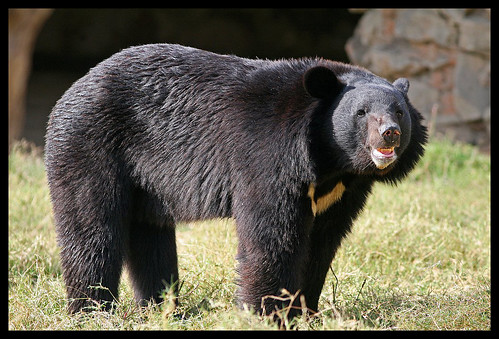
Asiatic black bears are medium sized
black bears with a distinct white patch on their chests
and have a white spot on their chins. Because of this on their chests people in Asia sometimes
call them Moon bears.
Their ears are good to help them be spotted (it helped me and
my mum work out who was who) because they are bigger than any other bears ears.
Size
They grow to 130 to 190 centimetres long and can weigh 100 to 200 kilograms.
The females are a lot smaller.
They live in forested areas and hill spots of southern Asia Afghanistan, Pakistan, northern India, Nepal, Sikkim, Bhutan, Burma, north-eastern China, south-eastern Russia, Taiwan, and on the Japanese islands of Shikoku and Honshu.
They probably don’t hibernate at winter time.
The cubs are born at different times of the year in different countries. They stay with their mums for two or three years. Sometimes the mother bears can be seen with cubs of different ages.
Asiatic black bears like to eat fruits, berries, insects, invertebrates
and small vertebrates and carrion.

Polar Bear


Polar bears are immediately recognisable because of their distinctive white colour of fur. They have a longer head and neck than all
the other bears but have quite small ears.
They have very big front paws, which are great for swimming.
Their feet have special skin underneath which helps them
walk on ice without slipping.
Polar bear walking across iceSize
Polar bears are the world’s biggest carnivore.
The adult males can grow to more
than 800 kilograms. Wow, that’s big! Females are about half the size
of the males and are 190 to 200 centimetres long.
The males are about 250 centimetres long.
Cubs weigh 600 to 700 grams when they are born
Polar bears live on the ice that floats on the sea in the Arctic Circle, although they can be found quite far south in Canada.
Polar bear with cubCubs
Polar bears usually give birth to two cubs (twins) in winter.
The babies stay with their mum for two and a half years.
They normally only give birth every three years
Polar bears like to eat seals, although in the summer time
some berries and grass. They are the most carnivorous of all the bears.
There used to be a polar bear at Belfast Zoo
but it was unhappy so they sent it to another zoo, where they thought
it would have a better life.

Sun Bear


The sun bear is the smallest member of the bear family.
Adults are round about 120 too 150 centimetres tall
and they weigh 27 to 65 kilograms.
Sun bears are easy to spot with their short sleek black fur
and unusual crescent shaped patch of yellow or white fur on their chest.
Their paws are large with long curved pointed claws
which are good for climbing trees.
Sun bears are found in lowland tropical rainforests of Southeast Asia.
Experts think they sleep in trees (Not the experts silly the bears!)
Sun bear at Belfast zooTheir diet is termites
small mammals, birds, growing tips of palm trees and nests of wild bees.
This means sun bears are omnivores.
Sun bear cub in a treeThe mother bears give birth to one or two cubs.
They each weigh about 325 grams.
They probably stay with their mother until they are fully grown.

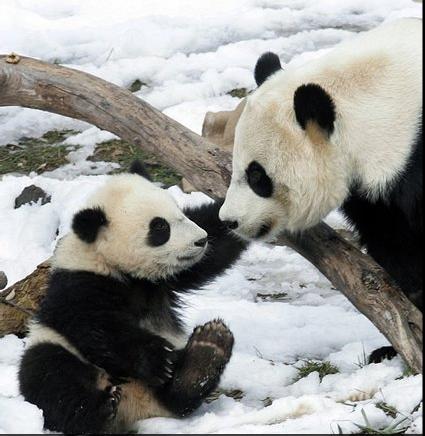
Giant Panda


The Latin name for Giant Panda is Ailuropoda Melaneuca.
The second word means “black and white” in Latin.
The pandas are one of the most recognisable mammals alive
because of their black and white fur. Adult Giant Pandas grow to sizes of 160 to 190 centimetres
and the adults weigh from 70 to 125 kilograms.
The babies would only weigh about 85 to 140 grams.
Giant Pandas live in mountain forests of southwest China.
This is where bamboo grows.
Giant pandas usually live on their own except when producing babies.
This is called a litter of cubs and they give birth to one two or sometimes even three but usually only one survives.
The cub will stay with mum for up to 48 months.
Baby pandas usually live in their mums tummy for three to five months.
The mother panda gives birth in a den she has made in a cave or a hollow tree.
The baby panda is tiny compared with its mum.
It is only 15 centimetres long and weighs only one thousandth the weight of an adult panda.
This panda cub is only one day old and its eyes are still closed.
They will not open until it is 6 weeks old.
Pandas use up to 14 hours a day eating food.
That would take a while but because the bamboo is not so filling it will also eat branches, leaves and small mammals.
They used to be carnivorous, but are now omnivorous, eating meat and plants
I know only two bamboo names, they are the Cold arrow and Walking stick.
Did you also know that pandas unlike us just sleep when they feel like it.
Giant pandas numbers are decreasing rapidly and soon there will not be enough in the world Just to picture how it
looks there are 1,000 giant pandas and more than 6 billion human beings in the world – that means that for every 6 million people on earth just one panda bear!People have found more ways to use bamboo too I hope there is enough to go around. The bamboo is being cut down faster than ever before.
Panda distribution in 1800 and today
This map shows where pandas used to live 200 years ago and where they live now.
One of the biggest threats to pandas is humans because of traditional beliefs that all the skin has magical powers and that their habitat is going as well as their food
because of us thinking it a useful plant too.

Types of Bears


There are eight different types of bear.
They are:-

Giant Panda
Sun Bear

Spectacled
Bear
Sloth bear
Polar Bear
Asiatic Black Bear
American Black Bear
Brown Bear

What is the weight of black bear?


Between 350-500 lbs
Most wild male black bears weigh between 125 and 500 pounds, while females generally weigh between 90 and 300 pounds.
Their weight depends upon their age, the season of the year, and how much food is available.
The heaviest wild male black bear known weighed 880 pounds
and the heaviest known female weighed 520 pounds. Black bears in captivity may exceed these records.
The world record weight for an American black bear is 880 pounds.
This was the recorded weight of a 10.75 year-old male bear shot in North Carolina in November 1998.
A black bear was hit and killed by a car near Winnipeg Canada, in 2001.
The official recorded weight was 856.5 pounds, but it is estimated that
the live weight of this large male was more than 886 pounds.
The driver was not injured and there appeared to be little damage to the Mazda.
An 805-pound male American black bear was shot in Manitoba Canada, and in Pennsylvania males fairly consistently reach the record weight of 800+ pounds.
Dear who ever, how much dose an average black bear weigh
a black bear weighs approximately 129.4kg to 159.6kg.

mountain lion drawing


mountain lion drawing