Showing posts with label Prairie Falcon. Show all posts

Thursday, January 7, 2010

Hans Von Aachen - Joking Couple


Artist: Hans Von Aachen
Title: Joking Couple
Museum: Kunsthistorisches Museum, Vienna, Austria

Hans von Aachen


German painter, born in Cologne (in spite of his name, which derives from his father s birthplace) and active in the Netherlands, Italy (1574-87), and most notably Prague, where he settled in 1596 as court painter to the emperor Rudolf II.
On Rudolf s death (1612) he worked for the emperor Matthias.
His paintings, featuring elegant, elongated figures, are - like those of his colleague Bartholomeus Spranger - leading examples of the sophisticated Mannerist art then in vogue at the courts of Northern Europe, and he was particularly good with playfully erotic nudes
( The Triumph of Truth, Alte Pinakothek, Munich, 1598).
Engravings after his work gave his style wide infiuence and
he ranks as one of the most important German artists of his time.

Wednesday, January 6, 2010

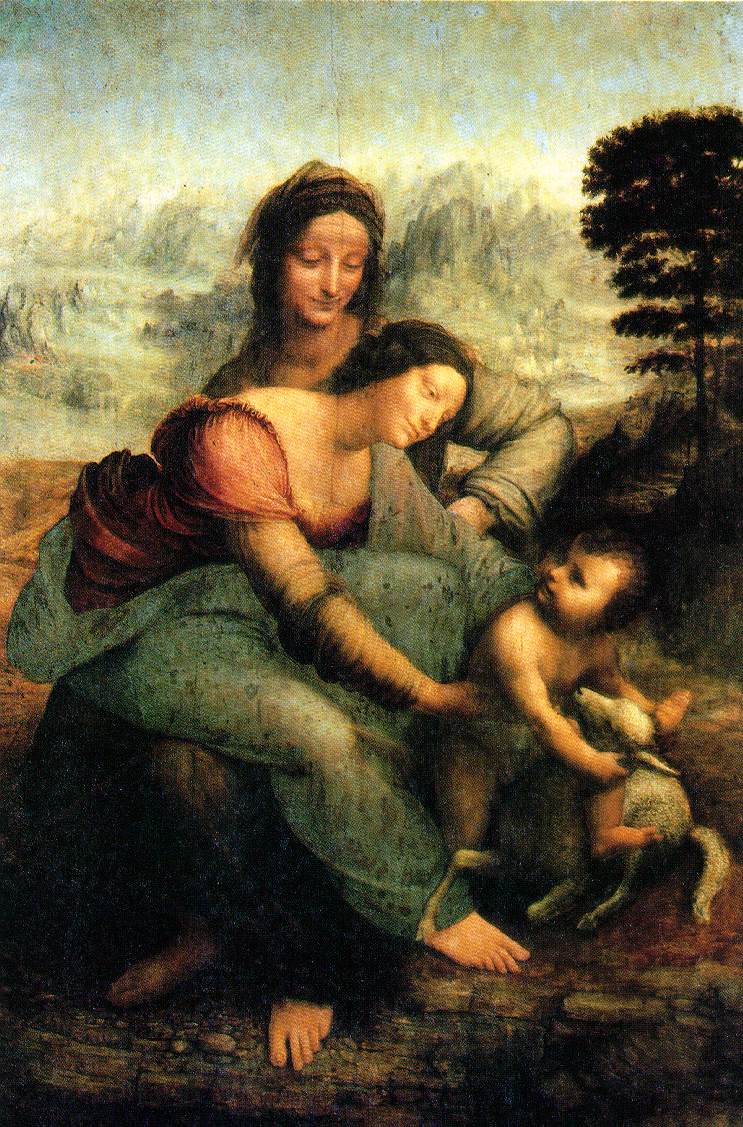
Virgin and Child with St. Anne - Leonardo da Vinci


Leonardo da Vinci -1502-1516
Virgin and Child with St. Anne
Oil on wood - Louvre

Leonardo da Vinci - Story life - part 7


In 1499, after the defeat of Ludovico Sforza by the French, Leonardo left Milan.
After briefly visiting Mantua, he moved on to Venice where he served as a military engineer.
In 1500, he returned to the city of his childhood, Florence.
There, he worked on a commission for the Servite monastery, which was probably Virgin and Child with St. Anne (c.1502-1516). In 1502, he was employed
by General Cesare Borgia as an architect and military engineer, with whom he traveled, mainly through Central Italy, studying terrain and preparing maps for Borgia's future military campaigns.
It was also around that time that the Madonna of the Yarnwinder (1501) was created.

Leonardo da Vinci - Story life - part 3


Another work of this period, The Annunciation(c.1472-1475) was attributed to Leonardo, but it is likely that the picture was not painted entirely by him.
However, it is generally accepted that the overall composition, the figure of the angel and the landscape are his work.
Other surviving works from this period include Madonna with the Carnation (c.1475), Madonna Benois (c.1475-1478), Portrait of Ginevra de'Benci (c.1478-1480).
Leonardo received a commission to paint an altar piece St. Hieronymus (c.1480-1482), which was never finished, and to create a large panel Adoration of the Magi (1481-1482) for the church in San Donato a Scopeto, which was not finished either.
Unfortunately, Leonardo's tendency to leave work unfinished was as characteristic
of him as his artistic genius.

Tuesday, December 8, 2009

Mona Lisa


Portrait of Mona Lisa (1479-1528), also known as La Gioconda, the wife of Francesco del Giocondo; 1503-06 (150 Kb); Oil on wood, 77 x 53 cm (30 x 20 7/8 in); Musee du Louvre, Paris

Michelangelo works - part1


Michelangelo Buonarroti was born in 1475 in Florence, Italy, and came
into his own at the height of the Renaissance.
For an artist of his talent and abilities, it was simply perfect timing.
Like his contemporary and rival Leonardo da Vinci, Michelangelo had a wide range of talents, including architecture, sculpture, painting, and poetry, all of which
he used prolifically during the course of his life.
The tasks he undertook were immense, many of them taking several years to complete.
If for no other reason, the sheer scale of some of his projects
(most notably the Sistine Chapel) is enough to prove Michelangelo’s place in history.

Sunday, November 22, 2009

polyborus plancus


MEASUREMENTS: The Crested Caracara has a body length of 19 - 23 inches, a 4-foot wingspan, and weighs 1 3/4 - 3 1/2 pounds.
The bird’s weight varies greatly depending on where it lives.
HABITAT: The Crested Caracaras’ preferred habitat is open, lowland countryside, like pastures, savannas, river edges, and ranches.
They may also be found in some forests and marshes.
These birds reside in the southwestern United States and Florida, Central America, and South America.
DIET: The Crested Caracara usually feeds on carrion, but they will take advantage of any food opportunity by eating small mammals, amphibians, reptiles, turtles, fish, crab, eggs, insects, worms, and nestling birds.
Caracaras hunt live food on the ground or take food from other birds.
REPRODUCTION: Crested Caracaras build a massive stick nest in a palm, cactus, tree, or on the ground. The female usually lays 2 - 3 eggs
that are incubated for 28 - 32 days. The young caracaras have a drawn out fledging period, taking up to 3 months before they are flying as independent birds.
NAME DERIVATION: The scientific name comes from poly, the Greek word for many or varied; boros, meaning gluttonous and remarks on the bird’s voracious appetite; and from the Latin word plancus, which is a word Aristotle used for an eagle.
The common name, caracara, is what South Americans called the bird and probably imitates the sound of the bird.
This bird has been called Caracara Eagle, King Buzzard, Mexican Eagle, Audubon’s Caracara
and Mexican Buzzard.
The scientific name of this bird was formerly Caracara cheriway.
INTERESTING FACTS:
-Unlike other members of the falcon family that do
not construct nests, the caracara builds a stick nest.
-The caracara is the most terrestrial bird in the falcon group.
It spends a great deal of time on the ground.

Prairie Falcon - INTERESTING FACTS


MEASUREMENTS: The Prairie Falcon has a body length of 15 - 20 inches, a 3 1/2 foot wingspan, and weighs 1 - 2 pounds.
HABITAT: Prairie Falcons inhabit hills, canyons, and mountains of arid grasslands
and shrub-steppes of southwestern Canada, western United States, Baja California, and northern Mexico.
DIET: The primary food of Prairie Falcons is small mammals, especially ground squirrels, but they will also hunt birds, reptiles, and insects.
This falcon actively searches for prey during flight. Prairie Falcons catch prey on or close to the ground after a low angled swoop from above.
REPRODUCTION: Typically, Prairie Falcons nest on a cliff face using a ledge, cavity, crevice, or an abandoned nest of eagles, hawks, or ravens. Prairie Falcons lay 3 - 6 eggs with an incubation time of about 34 days. Young falcons leave the nest 5 - 6 weeks after hatching.
NAME DERIVATION: The scientific name comes from the Latin word falco, meaning hook-shaped (falcate) and may refer to the beak and claws, and the Latinized name for Mexico, where the bird was first collected for scientific study. The common name mistakenly refers to the habitat in which this bird may be found.
True prairies are mostly outside this bird’s range.
INTERESTING FACTS:
- Prairie Falcons are probably just as fast as Peregrine Falcons, but do not typically use the same hunting strategy.
-Prairie and Peregrine Falcons are similar in size and can be distinguished from each other by color. The Prairie Falcon is brown and has dark “armpits” or dark patches under
the wings, while the Peregrine is blue-gray and has a uniform underwing color pattern.

Prairie Falcon


The Prairie Falcon is a medium-sized falcon of western North America.
It is about the size of a Peregrine Falcon or a crow, with
an average length of 40 cm , wingspan of 1 metre , and weight of 720 g (1.6 lb). As in all falcons, females are noticeably bigger than males.