Showing posts with label Falco araea. Show all posts

Sunday, November 22, 2009

polyborus plancus


MEASUREMENTS: The Crested Caracara has a body length of 19 - 23 inches, a 4-foot wingspan, and weighs 1 3/4 - 3 1/2 pounds.
The bird’s weight varies greatly depending on where it lives.
HABITAT: The Crested Caracaras’ preferred habitat is open, lowland countryside, like pastures, savannas, river edges, and ranches.
They may also be found in some forests and marshes.
These birds reside in the southwestern United States and Florida, Central America, and South America.
DIET: The Crested Caracara usually feeds on carrion, but they will take advantage of any food opportunity by eating small mammals, amphibians, reptiles, turtles, fish, crab, eggs, insects, worms, and nestling birds.
Caracaras hunt live food on the ground or take food from other birds.
REPRODUCTION: Crested Caracaras build a massive stick nest in a palm, cactus, tree, or on the ground. The female usually lays 2 - 3 eggs
that are incubated for 28 - 32 days. The young caracaras have a drawn out fledging period, taking up to 3 months before they are flying as independent birds.
NAME DERIVATION: The scientific name comes from poly, the Greek word for many or varied; boros, meaning gluttonous and remarks on the bird’s voracious appetite; and from the Latin word plancus, which is a word Aristotle used for an eagle.
The common name, caracara, is what South Americans called the bird and probably imitates the sound of the bird.
This bird has been called Caracara Eagle, King Buzzard, Mexican Eagle, Audubon’s Caracara
and Mexican Buzzard.
The scientific name of this bird was formerly Caracara cheriway.
INTERESTING FACTS:
-Unlike other members of the falcon family that do
not construct nests, the caracara builds a stick nest.
-The caracara is the most terrestrial bird in the falcon group.
It spends a great deal of time on the ground.

Friday, November 6, 2009

The fastest creatures on the earth


Forget about the fast and the furious, where all goes in a blast.
Let’s talk about the fastest creature on earth made by heaven
and own by our mother nature. If you’re amaze how can a Bugatti EB 16.4 Veyron take its speed from zero to 62 mph in 2.7 seconds (or 2.5 seconds)
Forget about the fast and the furious, where all goes in a blast.
Peregrine Falcons.
The scientific name is Falco peregrinus, peregrines- which derive from the Latin word wanderer, because it is known to roam or travel for an extended period of time, especially during the winter season. It is considered
as the endangered species in Canada and in the United States.
The Peregrine Falcon is not only considered as the fastest creatures in the sky, it's the swiftest birds and creature in the whole world that can fly horizontally at speed up to 55 mph.
It is known as the “Masters of the Hunt” (the raptors); where they knock out its prey in a downward dive over 270 mph.
There’s only 66% chance of escaping
when the peregrine falcon chased its favourite prey, it made a plunge over 270 mph to mashed their prey with its gigantic talons (something like a claw) and knock them out by colliding up in the sky.
The Peregrine Falcon uses their long, pointed wings and long narrow
tails to fly quickly and rapidly that make it as the fastest flying creatures in the whole world.
Cheetah.
t is known as a marvel of evolution, the wonder of the great earth and the spectacular fastest runner over the land, Cheetah, which uses their slender, long-legged body for speed, can reach up to 70 mph at its top speed (whew!!!)
The scientific name of Cheetah is Acinonyx jubatus, usually found in Southern and Eastern Africa, Middle East and in Southern Asia. It can cover or make a pace at
about seven-eight meters, with only one foot touching the ground at a time; the cheetah can make a speed of 110 km/h in just a second. Cheetah depends on sight not on smell
when it chase its prey with two points in the stride, feet not touching on the ground; it knock down their prey at once
by a suffocating bite to the neck. It chases 3.4 miles at
an average speed of 45 mph (72 km/h), last at about 20 seconds; which made it as the fastest animals over the land.
Sailfish.
Literally, sailfish has dark blue color on top, brown-blue laterally, silvery white below.
On the sides of the sailfish body has about twenty bars that are made up of bright blue spots. They have elongated bill which has a resemblance of a swordfish and a characteristics of sail (dorsal fin) on top, which often stretches the entire length of the back.
Istiophorus platypterus is the scientific name, which has a common size of 7 feet and mostly found in Florida. Most people believe that the Indo-Pacific Sailfish is the fastest creature among all the fishes for it covers or excess in its speed at about 110 km/h (68 mph) over a short period of time.
They usually have grown quickly at about 1.2 to 1.5 meters in length and 100 kg in weight. Fisherman and other spectators believed and seen
them leap to its height at about 6 m out of the water, and they calculated their swimming speed at 35. 2 km/h.
If a plane can fly in its incredible speed more than the peregrine falcon, that's totally amazing. If a person can run half of the Cheetah’s speed, she or he would break the record of the fastest creature on earth over the land; and if you can swim like
a sailfish and can reach at the same speed? Wow--Everybody are in completely amaze. Anyway, if you can run like a Cheetah, fly like a peregrine
falcon and swim like a sailfish, you will be considered as the most magnificent, spectacular and wondrous person living on earth.

Monday, November 2, 2009

Falco cuvierii


The African Hobby (Falco cuvierii) is a species of bird of prey in the Falconidae family.
It is found in Angola, Benin, Botswana, Burkina Faso, Burundi, Cameroon, Central African Republic, Chad, Republic of the Congo, Democratic Republic of the Congo, Ivory Coast, Ethiopia, Gabon, Gambia, Ghana, Guinea, Guinea-Bissau, Kenya, Liberia, Malawi, Mali, Mozambique, Namibia, Niger, Nigeria, Rwanda, Senegal, Sierra Leone, Somalia, South Africa, Sudan, Swaziland, Tanzania, Togo, Uganda, Zambia, and Zimbabwe.

Falco columbarius


The merlin, Falco columbarius, occurs in northern
coniferous forests around the world.
In North America, it breeds across Canada and in the
United States in Alaska and the northern Rocky Mountains. Populations in Canada and Alaska migrate south to winter in the western U. S., Mexico, and eastern coastal areas.
Migrants may cross large bodies of water.
During nonbreeding periods, a wide variety of habitats are used, including marshes, deserts, seacoasts, open woodlands, fields, and other open habitats.
Breeding sites are usually in conifer woodland or wooded prairie and are frequently near water.
Nests are built in trees in abandoned crow, magpie, hawk, or squirrel nests, or sometimes in natural tree cavities, abandoned woodpecker holes, bare cliff ledges, or on the ground in the arctic. Birds frequently return to the same nesting area in successive years.
Most eggs are laid in late May; clutches may contain between two and seven eggs, although usually three to five eggs are laid. Incubation lasts thirty-one or thirty-two days, and is done mostly by the female while the male brings food to the nest.
Young fledge after twenty-five to thirty-five days, but remain dependent on their parents for food for two to five more weeks.
Yearling males may help their parents raise young.
The diet of this hawk consists primarily of small to medium-sized birds
often flocking species. Large flying insects may be important prey for young learning to hunt.
At times, this bird may cache (store for late use) prey.

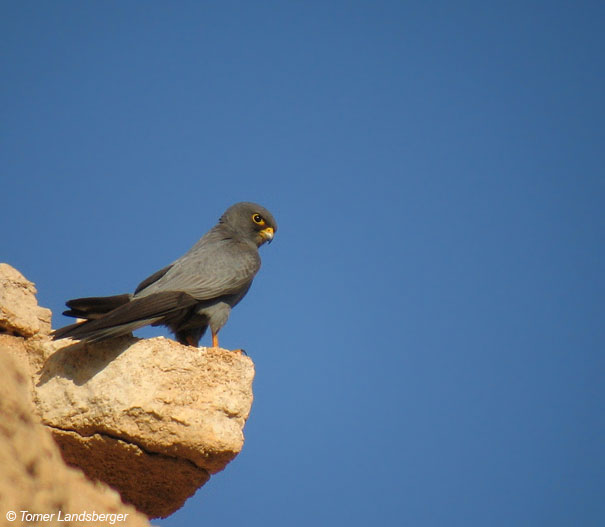
Falco concolor


The Sooty Falcon (Falco concolor ) is a medium-sized falcon breeding from northeastern Africa to the southern Persian Gulf region.
It belongs to the hobby group, a rather close-knit number of similar falcons often considered a subgenus Hypotriorchis.
Eleonora's Falcon is sometimes considered its closest relative
but while they certainly belong to the same lineage, they do not seem
to be close sister species.

Sunday, November 1, 2009

Falco dickinsoni


Dickinson's Kestrel (Falco dickinsoni) is a bird of prey of southern and eastern Africa belonging to the falcon family Falconidae. It is named after John Dickinson, an English physician and missionary who collected the type specimen.
It is also known as the White-rumped Kestrel.
Its closest relatives are the Grey Kestrel and Banded Kestrel and the three
are sometimes placed in the subgenus Dissodectes.
It inhabits savanna and open woodland, particularly swampy areas near water.
It is typically associated with palm trees and is also often found near baobab trees.
It occurs in coconut plantations in some areas.
Its range covers most of Mozambique, Zimbabwe, Zambia and Malawi along with north-eastern South Africa (mainly in Kruger National Park), northern Botswana, north-east Namibia, eastern Angola, southern Democratic Republic of the Congo and parts of Tanzania.
It is an occasional visitor to Kenya.
The total range is about 3.4 million km2. It is generally rather scarce but is commoner in some areas such as Zanzibar and
Pemba Islands. Loss of palm trees is a potential threat to the species.

Falco duboisi


The Réunion Kestrel (Falco duboisi) is an extinct bird of prey belonging
to the falcon family.
It inhabited the Mascarene island of Réunion and
was part of the Western Indian Ocean radiation of kestrels.
Known from subfossil bones and the writings of Dubois published in 1674
this bird was larger than its relative F. punctatus on Mauritius, being about the size of a Common Kestrel, or around 35 cm from head to tail, with males being noticeably smaller than females.
This trait, while present in most birds of prey, is most pronounced
in the larger, bird-eating species and reduces between-sex competition by niche differentiation. It can be assumed that
the bird was of the same generally brownish coloration as its closest relatives, with a lighter underside and darker spots or stipples, the tail, brown or more probably grey, being banded and tipped black. Its feet were yellow and large relative to the bird's overall size.
The wingspan was 60-70 cm
its wings being more rounded than those of the Common Kestrel - just as in the Mauritius bird - for increased maneuvrability when hunting in the forest. It is probable, but not certain, that the only difference between the sexes was their size.
The bird fed mainly on birds
but certainly also on insects and the local gecko; Dubois noted that despite their
small size they were able to prey on (presumably half-grown) domestic chickens.

Falco punctatus


The Mauritius Kestrel (Falco punctatus) is a bird of prey from the family Falconidae
endemic to the forests of Mauritius
where it is restricted to the southwestern plateau's forests, cliffs, and ravines.
It is the most distinct of the Indian Ocean kestrels.
It colonized its island home to evolve into a distinct species probably during the Gelasian (Late Pliocene.
It is the most distant living species among the
western Indian Ocean kestrels (Groombridge et al. 2002, qv Réunion Kestrel).
t can reach a size between 26 and 30.5 cm.
The weight is up to 250 grams. The males are slightly smaller than the females.
The wing is approximately 45 cm and are rounded, unlike those of other falcons.
The lifespan is 15 years in captivity.
The Mauritius Kestrel hunts by means of short, swift flights through forests.
It is carnivorous, eating geckos, dragonflies, cicadas, cockroaches, crickets, and small birds.

Falco araea


The mitochondrial cytochrome b gene analysis of Groombridge et al.
showed very strong support for the finding that this species and the Madagascar Kestrel, F. newtoni, have a common ancestor
but the relationship of these two species to the Mauritius Kestrel, F. punctatus, is still unresolved. The molecular results indicate that the Seychelles were colonized by kestrels from Madagascar between 0.3 and 1.0 MYA (million years ago)
much more recent than the origin of the Seychelles archipelago, which is estimated at 55-65 MYA. However, the intermediate Aldabra, Farquhar, and Ameriante islands may not have been exposed until the recent Pleistocene glacial cycles (Braithwaite 1984)
and this enhanced the opportunity for kestrels to colonize the Seychelles from Madagascar
Habitat and Habits: Like the Mauritius Kestrel, but to a lesser extent, this species shows some adaptations for forest dwelling (Groombridge et al. 2002), and prior to settlement by humans, the Seychelles were probably heavily forested.
It favors patches of forest among granite outcrops, but is also widespread in inhabited areas in lowlands with scattered palms and buildings (Kemp and Kemp 1998).
It spends much time perching on rockfaces, buildings, or among palm fronds and tree branches.
Food and Feeding Behavior: Feeds mainly on lizards, but also on small rodents, small birds, and insects. Prey is always taken from a perch (Feare et al. 1974) and is caught from branches, foliage, on the ground, or on the wing.
This species does not hover like some other kestrel species, and Feare et al. (1974) suggested that such an adaptation is not suited for foraging in forest.
Breeding: Nests mainly in rock cavities, but also at the base of palm fronds, on buildings, or in tree holes in developed areas (Kemp and Kemp 1968).
Conservation: Formerly more common and occurring on more islands (Vesey-Fitzgerald 1940). Increasing settlement on the Seychelles, following human colonization in 1770, resulted in the clearance of native forests for commercial forestry and agriculture during the 18th and 19th centuries and a decline in the kestrel population (Cheke 1987).
Numbers declined even more precipitously in the 1960s and 1970s, due to habitat degradation, persecution, predation by introduced mammals (rats and cats), and introduction in the 1950s of the Barn Owl, which became a serious predator on young and adult kestrels
Subsequently, the species has recovered to some extent
It is categorized as Vulnerable by BirdLife International.