Showing posts with label Polar Bear. Show all posts

Tuesday, December 8, 2009

Michelangelo works - part 3


Over 300 figures adorn the vaulted ceiling of that chapel, each of them painted solely by Michelangelo.
He’d originally began work with several assistants but it only took a short time before he became dissatisfied with the way the project was going and started
over by himself, letting no one but the Pope see his progress for the first three years.
It’s hard to get a real sense of the size and magnificence of the Sistine
Chapel unless you see it yourself, since any reproduction is limited to the space on a page or screen.
Because of that, I’ve chosen to show just two of the figures, rather than large sections.
Suffice it to say, it’s doubtful whether any work by an individual artist
will ever rival this masterpiece in scope, composition, or sheer impressiveness.

Wednesday, December 2, 2009

Goddess Minerva - Louvre Museum


Minerva, known also as Pallas Athena
in Greek mythology, was the Roman name of Greek goddess Athena.
She was considered to be the virgin goddess of warriors, poetry, medicine, wisdom, commerce, crafts, and the inventor of music

sculpture of the mythological


The Three Graces is a sculpture of the mythological three charites, daughters of Zeus – identified on some engravings of the statue as Euphrosyne
Aglaea and Thalia - who were said to represent beauty, charm and joy.
The Graces presided over banquets and gatherings
primarily to entertain and delight the guests of the Gods.

Saturday, November 28, 2009

Chartres


Chartres is a small city in the Centre-Val de Loire region of France, approximately an hour south-west of Paris by train. Population is 42,000 although that rises to 100,000 when the surrounding towns are taken into consideration.
The main attraction for most visitors to
Chartres is the 12th century cathedral, considered by many
art historians to be the finest surviving example from the High Gothic period.
In the last couple of years a new mayor has overseen the modernization
of the center of the town.
There has provoked both positive and negative reactions
from the "Chartrains", but there is no doubt that the town is undergoing a certain renewal.

Clos-Luce Castle


This residence of pink brick was built by Hugues d'Amboise on Gallo-Roman foundations in the reign of Louis XI (between 1107 and 1115).
The property was then given by the king to his favourite, Etienne le Loup, a cook's assistant whom he ennobled.
The estate, which was called the Manoir du Cloux at that time
was surrounded by fortifications, all that remains today being the watchtower.
At the bottom of the park, Etienne Le Loup also had a dovecote
which is still intact, and which could house 500 pigeons.
Bought by Charles VIII on 2nd July 1490, the castle became a royal estate.
It was to remain so for two centuries.
While the Royal Court resided at the Château d'Amboise in the Loire Valley, the Manoir du Cloux was used as a secondary residence. Charles VIII had the chapel
built here for the Queen, Anne de Bretagne, in mourning for her children who died young.
Later, the young Duke of Angouleme, the future Francis I, organised war games in the gardens of the Clos-Lucé. Marguerite de Navarre, the sister of Francis I, wrote the first erotic stories of "L'Heptaméron" there.
It was under Francis I that Le Clos-Lucé became the house symbolising the Renaissance movement in France. Advised by his sister, Francis I had painters, architects, and poets, such as Clément Marot, who were seeking royal protection, brought here.
But the greatest of those to cross the threshold of Le Clos Lucé was certainly Leonardo da Vinci.

Chenonceau Castle - france


Built on the river Cher, where the unique beauty of its architecture reflects in the water, the Château de Chenonceau is the Val de Loire’s finial.
Château des Dames as recorded in the French history books, Chenonceau owes a large part of its charm to women: it was built in 1513 by Katherine Briçonnet, then made even more attractive by Diane de Poitiers and Catherine de Médicis, and saved from the rigours of the French Revolution by Mrs Dupin.
The lovely surroundings, the formal garden and the park surrounding
it add to the impression of delicate grace emanating from the castle.
Chenonceau is not only remarkable for its architecture and history but also
for the fine quality of its collections as can be seen from the inside visit: Renaissance furniture, a vast ensemble of XVI th and XVII th centuries tapestries
and a great number of masterpieces. Le Primatice, Rubens, Le Tintoret, Rigaud, Nattier, Van Loo are among the most famous names that can be found ther
The estate of Chenonceau is mentioned for the first time
in writing towards the end of the XIth century.
From the XIIIth to the XVth century, the estate of Chenonceau, with its unprepossessing feudal manor, was the property of the Marques family.
1411 : A royal order to punish Jean Marques for an
act of sedition included an order for the destruction of the manor.
1432 : Jean Marques had a castle and a fortified mill
built to replace the lost manor of Chenonceau.

Friday, November 27, 2009

Chartres Cathedral


The Chartres Cathedral of France is situated in Chartes
about eighty kilometers southwest of Paris.
It is one of the best & most famous churches in the entire France.
It is counted third best among the Gothic style of architecture.
It’s full name is the Cathedral of Our Lady of Chartres.
It is a beautiful sight to see from a distance, between the wheat fields and only when tourists come closer to the church, it stands on the top of the hill and stands out in beauty.
The Chartres Cathedral was built in the 16th century and it has two Spires
the first one is 349 feet and the other is 377 feet tall.
As far as the history of the cathedral goes, this cathedral was said to be the most imperative building in the city. It acted as a big landmark for the local public
and also for the nearby visitors. All important activities were entered around the cathedral. Sometimes during the middle age, the cathedral worked as the market place.
In the middle of all this, the priests however were always against the cathedral being used as a market place.
So much so, that they did not allow people selling wine in the crypt.
The cathedral was a common assembly point for different kinds of workmen to find jobs for themselves.
The Chartres Cathedral is one of the most visited Gothic churches in the entire France.
The Chartres was a place where pilgrims used to come
quite often and during older days, the church used to be a hospital to take care of the sick.

St. Omer - north of France


St.Omer was a famous trade city in the Middle Age.
Not a lot remains of this glorious past, unhappily, but you can still see its old market and the ruins of an abbey where died the last Merovingian king, at the end of the VIIth century.
Located at the border between Flanders and Artois, Saint Omer is also famous
in the region for its swamp, the "marais audomarois": there, people cultivate vegetables and sell them on small boats.
I recommend you the inhabitants, among the friendliest French.
it's worth a stopover just for that! P.S.:
There is no train station at Saint Omer; one must go down at Hazebrouck, 20 Km away... This last is incorrect - it is served by trains between Calais and Lille.

Sunday, November 22, 2009

Peregrine Falcon


The Peregrine Falcon also known simply as the Peregrine,and historically as the "Duck Hawk" in North America, is a cosmopolitan bird of prey in the family Falconidae.
It is a large, crow-sized falcon, with a blue-gray back, barred white underparts
and a black head and "moustache".
It can reach speeds over 320 km/h (200 mph) in a dive, making it the fastest animal in the world. [4] As is common with bird-eating raptors, the female is much bigger than the male.
Experts recognize 17-19 subspecies
which vary in appearance and range; there is disagreement over
whether the distinctive Barbary Falcon is a subspecies or a distinct species.

Saturday, November 21, 2009

The Gyrfalcon


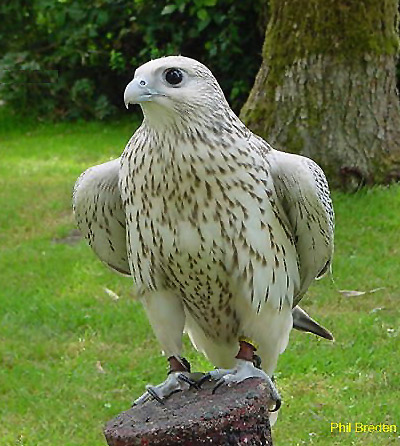
The Gyrfalcon eats mostly ptarmigan, but many other prey species have been recorded
including fulmars, gulls, jaegers, ducks, geese, Rough-legged Hawk, Short-eared Owl, sparrows, buntings, and redpolls.
The female Gyrfalcon regularly stores prey during the breeding season, generally within 100 meters (328 feet) of the nest.
Little is known of food-caching outside the breeding season; in one case, a Gyrfalcon was seen retrieving a frozen ptarmigan and chipping
off pieces of meat to eat, in mid-winter in the Aleutian Islands.
Gyrfalcon is pronounced as "JER-falcon." The name probably evolved from
Old Norse, but linguists do not completely agree on the specific origin of the word.
The Gyrfalcon sometimes bathes in runoff water of still-frozen rivers.
Mostly birds, especially ptarmigan. Also consumes mammals, ranging in size from voles to hares.

Friday, November 6, 2009

Falcons - general information


Falcons are medium sized birds of prey found all across
the world although falcons tend to prefer the more temperate regions of the
Northern Hemisphere. Falcons are best known for
their ruthlessness and their incredible flying abilities.
Falcons have tapered wings that allow the falcon to change direction extremely quickly especially when compared to other birds.
Falcons have been recorded diving at speeds of up to 200mph
meaning they are the fastest creatures on the planet!
There are more than 40 different species of falcon that can be found all around the world such as the peregrine falcon and the black falcon.
Falcons vary in size from 25cm tall to more than 60cm tall, but the height of the falcon depends on the species. The peregrine falcon is the most common
bird of prey in the world and is found on every continent besides Antarctica.
Falcons are birds of prey and are therefore known for their incredible hunting skills and being a ruthless, dominant predator within their environment.
Falcons hunt their prey from the skies above and swoop down through the air to catch it once they have spotted a meal with their incredible eyesight.
Falcons hunt all kinds of small animals like mice, frogs, fish and falcons will even catch small birds in the air.
Due to the large size, speed and alertness of the falcon, the falcon has few natural predators and even fewer that are actually airborne.
Humans and wolves tend to be the main predators of the falcon on the ground and eagles and even large owls have been known to hunt the smaller species of falcon in the air.
The eggs and chicks of the falcon are particularly vulnerable to being eaten.
Falcons have adapted in many ways to maximise their chances of survival in the skies.
The falcon has tapered wings that allow the falcon to be more agile; incredibly acute eyesight which enables the falcon to spot prey
on the ground far below; an aerodynamic body shape means that the falcon glides through the air more easily and a sharp pointed beak helps the falcon to grab and eat it's prey more effectively.
Falcons nest on high ground such as mountains and cliffs and in the tops of tall trees.
This means that the vulnerable eggs and chicks of the
falcon are in the safest place possible.
Falcons start to breed when they are about a year old.
Female falcons lay an average of 3 eggs per clutch and look after their
chicks until they are big enough and strong enough to fend for themselves.
Falcons are generally solitary birds and only really come together to mate.
Although falcons are known to stay in the same place, many species of falcon are migratory birds and have been known to travel more than 15,000 miles per year.

Monday, November 2, 2009

Falco cuvierii


The African Hobby (Falco cuvierii) is a species of bird of prey in the Falconidae family.
It is found in Angola, Benin, Botswana, Burkina Faso, Burundi, Cameroon, Central African Republic, Chad, Republic of the Congo, Democratic Republic of the Congo, Ivory Coast, Ethiopia, Gabon, Gambia, Ghana, Guinea, Guinea-Bissau, Kenya, Liberia, Malawi, Mali, Mozambique, Namibia, Niger, Nigeria, Rwanda, Senegal, Sierra Leone, Somalia, South Africa, Sudan, Swaziland, Tanzania, Togo, Uganda, Zambia, and Zimbabwe.

Falco columbarius


The merlin, Falco columbarius, occurs in northern
coniferous forests around the world.
In North America, it breeds across Canada and in the
United States in Alaska and the northern Rocky Mountains. Populations in Canada and Alaska migrate south to winter in the western U. S., Mexico, and eastern coastal areas.
Migrants may cross large bodies of water.
During nonbreeding periods, a wide variety of habitats are used, including marshes, deserts, seacoasts, open woodlands, fields, and other open habitats.
Breeding sites are usually in conifer woodland or wooded prairie and are frequently near water.
Nests are built in trees in abandoned crow, magpie, hawk, or squirrel nests, or sometimes in natural tree cavities, abandoned woodpecker holes, bare cliff ledges, or on the ground in the arctic. Birds frequently return to the same nesting area in successive years.
Most eggs are laid in late May; clutches may contain between two and seven eggs, although usually three to five eggs are laid. Incubation lasts thirty-one or thirty-two days, and is done mostly by the female while the male brings food to the nest.
Young fledge after twenty-five to thirty-five days, but remain dependent on their parents for food for two to five more weeks.
Yearling males may help their parents raise young.
The diet of this hawk consists primarily of small to medium-sized birds
often flocking species. Large flying insects may be important prey for young learning to hunt.
At times, this bird may cache (store for late use) prey.

Falco amurensis


The Amur Falcon (Falco amurensis), formerly Eastern Red-footed Falcon
is a small raptor of the falcon family.
It breeds in south-eastern Siberia and Northern China, wintering in Southern Africa.
Males are characteristically dark sooty brown, and may offer confusion with melanistic Gabar Goshawk, but the chestnut on the vent should prevent confusion here.
Also there may be some superficial resemblance to Sooty Falcon and Grey Kestrel, but those two species both have yellow feet and cere.
Separating male Amur and Red-footed Falcons is best done
by the white underwing coverts on Amur Falcon, whereas the underwing of male Red-footed Falcons is uniformly grey.
Females may offer a bit more confusion with a wider range of falcons as they have a typical falcon head pattern.
The grey on the top of the head should quickly rule out confusion with Red-footed Falcons. The female has barring on the lower belly. Red cere and feet rule out all other falcons.

Saturday, October 31, 2009

falcon - facts


AT RIGHTaround forty days, young Peregrines begin flying. Peregrine parents encourage flight by "baiting" the young with food, which is no longer neatly prepared and fed directly to the young. It is a lot of fun to watch young Peregrines chasing each other and everything else!
As in many other species, Peregrine young learn in part through "playing" - however, this play can be deadly serious when hunting is involved.
Peregrines hunt and eat other birds and are famed
for their speed (stooping, or diving, Peregrines
have been clocked at speeds of up to 220mph) and aerial prowess.
Here are some bird
fact sheets from one of my OTHER favorite web sites, the Animal Diversity Web

Thursday, October 22, 2009

Polar bear fur


There’s this myth floating around that polar bear fur is fiber optic.
It’s not. It’s not it’s not it’s not.
The myth goes like this
polar bears are white, but they have to keep warm in the winter.
But white reflects light and heat, so how do they do it?
By having fiber optic fur.
“Fiber optics” are a type of “light pipe” that channels light extraordinarily well, sort of like an electric wire does for electric current.
So, this is supposed to heat them up by channeling light to their black skin.
This is based on research that showed that polar bears are
white to you and me, but don’t emit any ultraviolet (UV) light (they’re black in the ultraviolet).
They thought the UV radiation was being absorbed by fiber optics and transported to the skin. It turns out instead that polar bear
fur just absorbs UV on its own because of what it’s made of.
So this is an example of an early, incorrect science report getting circulated and taking hold in the popular mind.
This myth gets perpetuated by the fact that polar bear fur is hollow.
Fiber optics are also hollow, but not every hollow thing is a fiber optic (this is like the “a square is a rectangle but a rectangle isn’t always a square” thing).

Polar Bear - wallpaper


Polar Bear - wallpaper

Polar Bear


Polar bears are immediately recognisable because of their distinctive white colour of fur. They have a longer head and neck than all
the other bears but have quite small ears.
They have very big front paws, which are great for swimming.
Their feet have special skin underneath which helps them
walk on ice without slipping.
Polar bear walking across iceSize
Polar bears are the world’s biggest carnivore.
The adult males can grow to more
than 800 kilograms. Wow, that’s big! Females are about half the size
of the males and are 190 to 200 centimetres long.
The males are about 250 centimetres long.
Cubs weigh 600 to 700 grams when they are born
Polar bears live on the ice that floats on the sea in the Arctic Circle, although they can be found quite far south in Canada.
Polar bear with cubCubs
Polar bears usually give birth to two cubs (twins) in winter.
The babies stay with their mum for two and a half years.
They normally only give birth every three years
Polar bears like to eat seals, although in the summer time
some berries and grass. They are the most carnivorous of all the bears.
There used to be a polar bear at Belfast Zoo
but it was unhappy so they sent it to another zoo, where they thought
it would have a better life.