Showing posts with label birds. Show all posts

Saturday, November 28, 2009

Chateau de Chambord


The royal Château de Chambord at Chambord, Loir-et-Cher, France is one of the most recognizable châteaux in the world because
of its very distinct French Renaissance architecture
that blends traditional French medieval forms with classical Italian structures.
Chambord is the largest castle in the Loire Valley, but was built to serve
only as a hunting lodge for François I, who maintained
his royal residences at Château de Blois and at Château d'Amboise.
The original design of the Château de Chambord is attributed, though with several doubts, to Domenico da Cortona, whose wooden model for the design survived long enough to be drawn by André Félibien in the seventeenth century.

Sunday, November 22, 2009

Facts About earth in September Equinox


There are two interesting facts which are not
often noticed, but should be shared
with students to get them interested in this subject.
First, the equinox( falling this year on September 22, 2009) means that the length
of the day is exactly the same all over the earth: from the North Pole
to the South Pole, and from both Temperate Zones, to the Tropics, to the Equator.
Second, which I’ve noticed over many years of watching the world weather, is that TEMPERATURES equal distances north and south
of the equator (in similar continental zones, of course), are roughly the SAME at this time of year.
For example, I live in North Africa. Having travelled many
years ago to Cape Town, South Africa, I’ve continued to watch
the temperatures there, comparing them with the North African temperatures.
Around the time of either the March or September equinoxes, the temperatures
in both North Africa and South Africa are roughly the same!

Prairie Falcon - INTERESTING FACTS


MEASUREMENTS: The Prairie Falcon has a body length of 15 - 20 inches, a 3 1/2 foot wingspan, and weighs 1 - 2 pounds.
HABITAT: Prairie Falcons inhabit hills, canyons, and mountains of arid grasslands
and shrub-steppes of southwestern Canada, western United States, Baja California, and northern Mexico.
DIET: The primary food of Prairie Falcons is small mammals, especially ground squirrels, but they will also hunt birds, reptiles, and insects.
This falcon actively searches for prey during flight. Prairie Falcons catch prey on or close to the ground after a low angled swoop from above.
REPRODUCTION: Typically, Prairie Falcons nest on a cliff face using a ledge, cavity, crevice, or an abandoned nest of eagles, hawks, or ravens. Prairie Falcons lay 3 - 6 eggs with an incubation time of about 34 days. Young falcons leave the nest 5 - 6 weeks after hatching.
NAME DERIVATION: The scientific name comes from the Latin word falco, meaning hook-shaped (falcate) and may refer to the beak and claws, and the Latinized name for Mexico, where the bird was first collected for scientific study. The common name mistakenly refers to the habitat in which this bird may be found.
True prairies are mostly outside this bird’s range.
INTERESTING FACTS:
- Prairie Falcons are probably just as fast as Peregrine Falcons, but do not typically use the same hunting strategy.
-Prairie and Peregrine Falcons are similar in size and can be distinguished from each other by color. The Prairie Falcon is brown and has dark “armpits” or dark patches under
the wings, while the Peregrine is blue-gray and has a uniform underwing color pattern.

Prairie Falcon


The Prairie Falcon is a medium-sized falcon of western North America.
It is about the size of a Peregrine Falcon or a crow, with
an average length of 40 cm , wingspan of 1 metre , and weight of 720 g (1.6 lb). As in all falcons, females are noticeably bigger than males.

Saturday, November 21, 2009

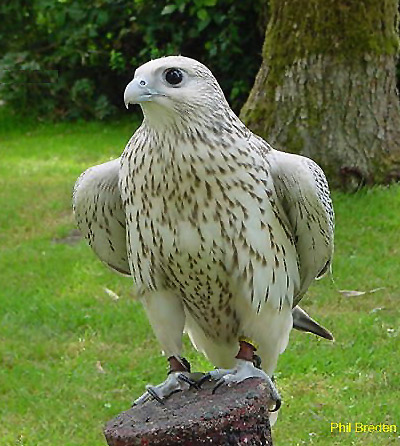
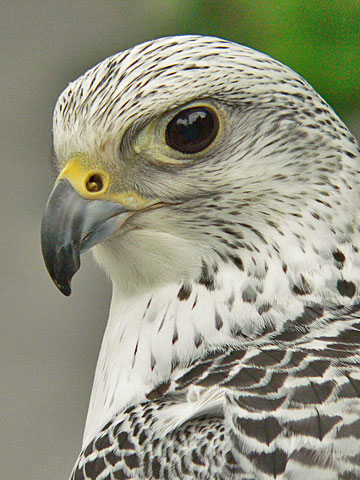
The Gyrfalcon


The Gyrfalcon eats mostly ptarmigan, but many other prey species have been recorded
including fulmars, gulls, jaegers, ducks, geese, Rough-legged Hawk, Short-eared Owl, sparrows, buntings, and redpolls.
The female Gyrfalcon regularly stores prey during the breeding season, generally within 100 meters (328 feet) of the nest.
Little is known of food-caching outside the breeding season; in one case, a Gyrfalcon was seen retrieving a frozen ptarmigan and chipping
off pieces of meat to eat, in mid-winter in the Aleutian Islands.
Gyrfalcon is pronounced as "JER-falcon." The name probably evolved from
Old Norse, but linguists do not completely agree on the specific origin of the word.
The Gyrfalcon sometimes bathes in runoff water of still-frozen rivers.
Mostly birds, especially ptarmigan. Also consumes mammals, ranging in size from voles to hares.

Gyrfalcon


The gyrfalcon is the largest of all falcon species.
The Gyrfalcon breeds on Arctic coasts and islands of North America, Europe and Asia.
It is mainly resident, but some Gyrfalcons disperse more widely
after the breeding season, or in winter .
Its scientific name is composed of the Latin terms for a falcon, Falco, and for
someone who lives in the countryside, rusticolus.
This species is a very large falcon, about the same size as the largest buteos.
Males are 48 to 61 cm long, weigh 805 to 1350 g
and have a wingspan from 110 to 130 cm (43 to 51 in).
Females are rather bulkier and larger at 51 to 65 cm (20 to 26 in) long,
a weight of 1180 to 2100 g (2.6 to 4.6 lbs) and have a wingspan ranging from 124 to 160 cm .
In dimensions, gyrfalcons lie between
a large Peregrine Falcon and a hawk in general structure; they are unmistakably falcons with pointed wings, but are stockier, broader-winged, and longer-tailed than the Peregrine.

United Arab Emirates arab falcons stamps


United Arab Emirates arab falcons stamps - issued on November 17, 2003.

Falcon - pictures


Falcon - pictures

Friday, November 6, 2009

Falcons - general information


Falcons are medium sized birds of prey found all across
the world although falcons tend to prefer the more temperate regions of the
Northern Hemisphere. Falcons are best known for
their ruthlessness and their incredible flying abilities.
Falcons have tapered wings that allow the falcon to change direction extremely quickly especially when compared to other birds.
Falcons have been recorded diving at speeds of up to 200mph
meaning they are the fastest creatures on the planet!
There are more than 40 different species of falcon that can be found all around the world such as the peregrine falcon and the black falcon.
Falcons vary in size from 25cm tall to more than 60cm tall, but the height of the falcon depends on the species. The peregrine falcon is the most common
bird of prey in the world and is found on every continent besides Antarctica.
Falcons are birds of prey and are therefore known for their incredible hunting skills and being a ruthless, dominant predator within their environment.
Falcons hunt their prey from the skies above and swoop down through the air to catch it once they have spotted a meal with their incredible eyesight.
Falcons hunt all kinds of small animals like mice, frogs, fish and falcons will even catch small birds in the air.
Due to the large size, speed and alertness of the falcon, the falcon has few natural predators and even fewer that are actually airborne.
Humans and wolves tend to be the main predators of the falcon on the ground and eagles and even large owls have been known to hunt the smaller species of falcon in the air.
The eggs and chicks of the falcon are particularly vulnerable to being eaten.
Falcons have adapted in many ways to maximise their chances of survival in the skies.
The falcon has tapered wings that allow the falcon to be more agile; incredibly acute eyesight which enables the falcon to spot prey
on the ground far below; an aerodynamic body shape means that the falcon glides through the air more easily and a sharp pointed beak helps the falcon to grab and eat it's prey more effectively.
Falcons nest on high ground such as mountains and cliffs and in the tops of tall trees.
This means that the vulnerable eggs and chicks of the
falcon are in the safest place possible.
Falcons start to breed when they are about a year old.
Female falcons lay an average of 3 eggs per clutch and look after their
chicks until they are big enough and strong enough to fend for themselves.
Falcons are generally solitary birds and only really come together to mate.
Although falcons are known to stay in the same place, many species of falcon are migratory birds and have been known to travel more than 15,000 miles per year.

Sunday, November 1, 2009

Saturday, October 31, 2009

Falco Peregrinus


THE PEREGRINE falcon's scientific name is Falco Peregrinus, which means Falcon Wanderer. Three subspecies are recognized in North America: F.P. Pealei from the coastal islands off Alaska; F.P. Tundrius, which nests above the tree line in the Arctic; and F.P. Anatum, which once ranged over North America from coast to coast. In the 1960s, scientists discovered that DDT was interfering in the egg shell formation of meat and fish eating birds. Healthy birds were laying eggs so thin they were crushed by the weight of the incubating adult. By 1965, no Peregrine falcons were fledged in the eastern or Central United States. By 1968, the Peregrine population was completely eradicated east of the Mississippi River. In 1972, use of DDT was severely restricted in the United States and worldwide.