Showing posts with label Philosophers. Show all posts

Sunday, January 10, 2010

Juan Martín Cabezalero


Juan Martín Cabezalero (1633-1673) was a Spanish draftsman and painter.
Born in Almadén, he studied under Juan Carreño de Miranda, court painter to Charles II of Spain; Cabezalero lived at Carreño de Miranda's house until 1666.
Both he and Carreño were influenced by Van Dyck.
Few works by Cabezalero have survived.
His surviving works include his St Jerome (1666, Meadows Museum, Southern Methodist University, Dallas) and the Assumption of the Virgin (ca. 1670; Madrid, Prado).
The latter had been formerly attributed to Mateo Cerezo, also a pupil of Carreño de Miranda.
Antonio Palomino praises Cabezalero's modest, studious nature and laments that he died young.

Thursday, January 7, 2010

Friday, December 11, 2009

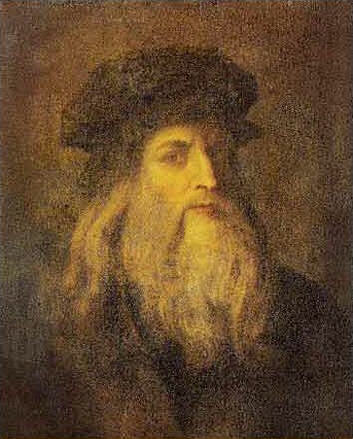
Leonardo da Vinci


Leonardo was an Italian polymath, scientist, mathematician, engineer, inventor, anatomist, painter, sculptor, architect, botanist, musician and writer.
Whew! Often described as the archetype of the renaissance man
Leonardo’s unquenchable curiosity was rivaled only by his powers of invention.

Tuesday, December 8, 2009

Portrait of Cecilia Gallerani


Leonardo da Vinci 9
Portrait of Cecilia
Gallerani (Lady with
an Ermine). c.1490
Oil on wood.
Czartorychi Muzeum
Cracow, Poland

His Last Supper - Leonardo Da Vinci


Painting by Leonardo Da Vinci, 1498

Wednesday, December 2, 2009

Democritus of Abdera - Philosophers


One of the solutions to the problem postulated by
Parmenides of Elea, was the hypothesis of Democritus of Abdera: matter is made up from atoms.
There was no real evidence for this idea (which was not completely new), but it explained why change was possible.
The atoms were always moving and clustering in various, temporary combinations.
Therefore, things seemed to change, but 'not being' never
changed into 'being'. (It was assumed that 'not being' was a vacuum, which means that it is in fact not a 'not being' because a vacuum exists in four dimensions.)
The consequence of this idea is that we are allowed to
use our senses, although Democritus warns us to be careful.

Parmenides of Elea - Philosophers


Parmenides of Elea was a younger contemporary of Heraclitus of Ephesus, but he lived at the opposite end of the Greek world: in Italy.
Both men were intrigued by the immense variety of phenomena, but where Heraclitus discerned order in the chaos, Parmenides pointed out that the endless
variety and eternal changes were just an illusion.
In a long poem, which partially survives, he opposed 'being' to 'not being', and pointed out that change was impossible, because it would mean that something that was 'not being' changed into 'being', which is absurd.
In other words, we had to distrust our senses and rely solely on our intellect.
The result was a distinction between two worlds: the unreal world which we experience every day, and the reality, which we can reach by thinking.
This idea was to prove one of the most influential in western culture.

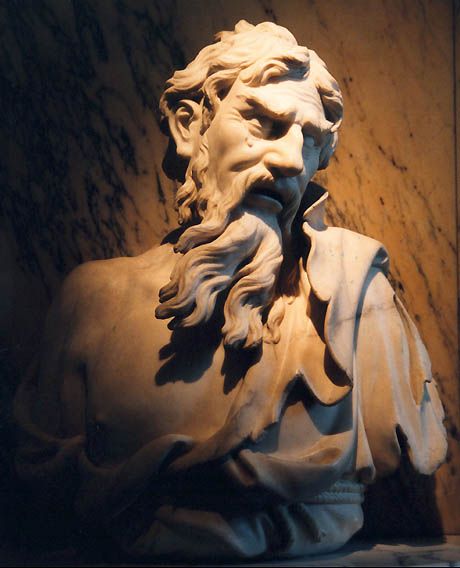
Heraclitus - Philosophers


Heraclitus was a rich man from Ephesus and lived c.500, during the Persian occupation
of his home town.
His philosophical work consists of a series of cryptical pronouncements that force a reader to think. Unfortunately, a great part of his work is lost, which makes it very difficult to reconstruct Heraclitus' ideas.
It seems certain, however, that he thought that the basic principle of the universe was the logos, i.e. the fact that it was rationally organized and therefore understandable.
Bipolar oppositions are one form of organization, but the sage understands
that these oppositions are just aspects of one reality.
Fire is the physical aspect of the perfect logos.